










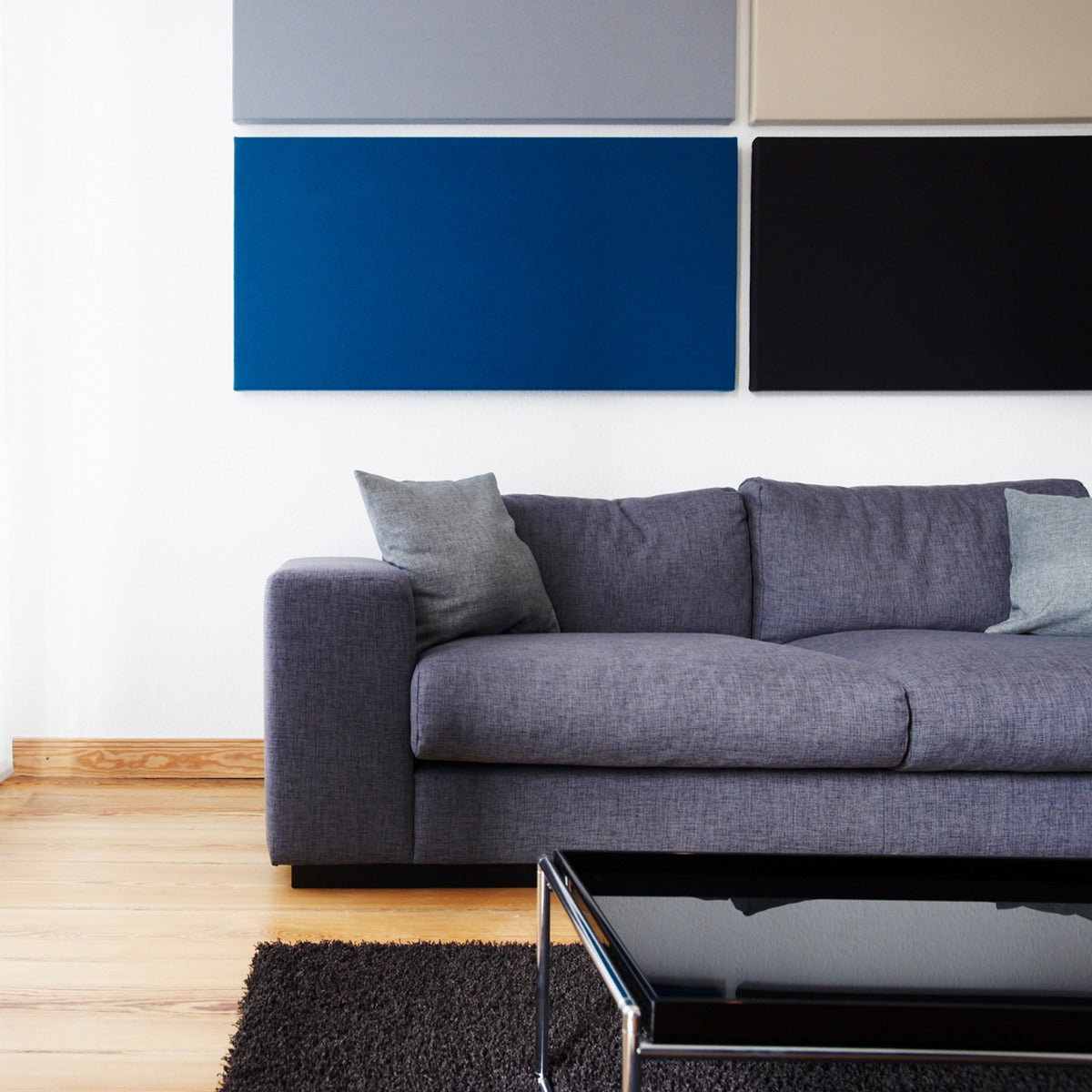


When you're comparing fabric vs PET acoustic panels for an office, studio, or village hall, the number that matters most is the Noise Reduction Coefficient, and the gap between the two materials is bigger than you might expect.
Professional fabric-wrapped panels can achieve an αw of 0.85 to 1.00, meaning they absorb almost every sound wave that hits them, while budget alternatives routinely fall well short of that mark. We get asked which material performs better almost every week, and the honest answer depends on what you're treating, how the room is used, and how much of your budget goes toward the fabric or facing rather than the acoustic core underneath it.
| Fabric-Wrapped | PET Felt | |
|---|---|---|
| αw rating | 0.85 – 1.00 | 0.40 – 0.60 |
| Best for | Full-spectrum absorption, reverberation control | Speech clarity, mid/high frequencies |
| Typical use case | Offices, churches, village halls, sports halls | Classrooms, small meeting pods, corridors |
| Weight | Heavier | Lighter |
| Cost per m² | £149 – £278 (SilentSpace fabric-wrapped, size-dependent) | £93 – £96 (Autex Cube 12mm) |
| Lifespan | 20+ years |
2–3 years (budget grades) Autex - 10+ years |
Fabric vs PET Acoustic Panels: The Headline Difference
Walk into a room with painted plaster walls, a hard floor, and a bank of windows, and sound will bounce back and forth rapidly, building up into a noise floor that makes speech hard to follow. Both fabric-wrapped and PET felt panels are designed to interrupt that cycle.
The headline difference is what happens once sound energy reaches the panel face. Fabric-wrapped panels wrap a porous acoustic core, usually mineral wool or high-density glass fibre, in a taut textile.
That combination lets sound pass through the fabric, get trapped and dissipated inside the dense core, and never bounce back. PET panels use compressed recycled polyester fibre as both the structure and the finish, which absorbs well at certain frequencies but is typically less dense than a wrapped mineral wool core.
How Fabric-Wrapped Panels Work: αw, Absorption, and Speech Intelligibility
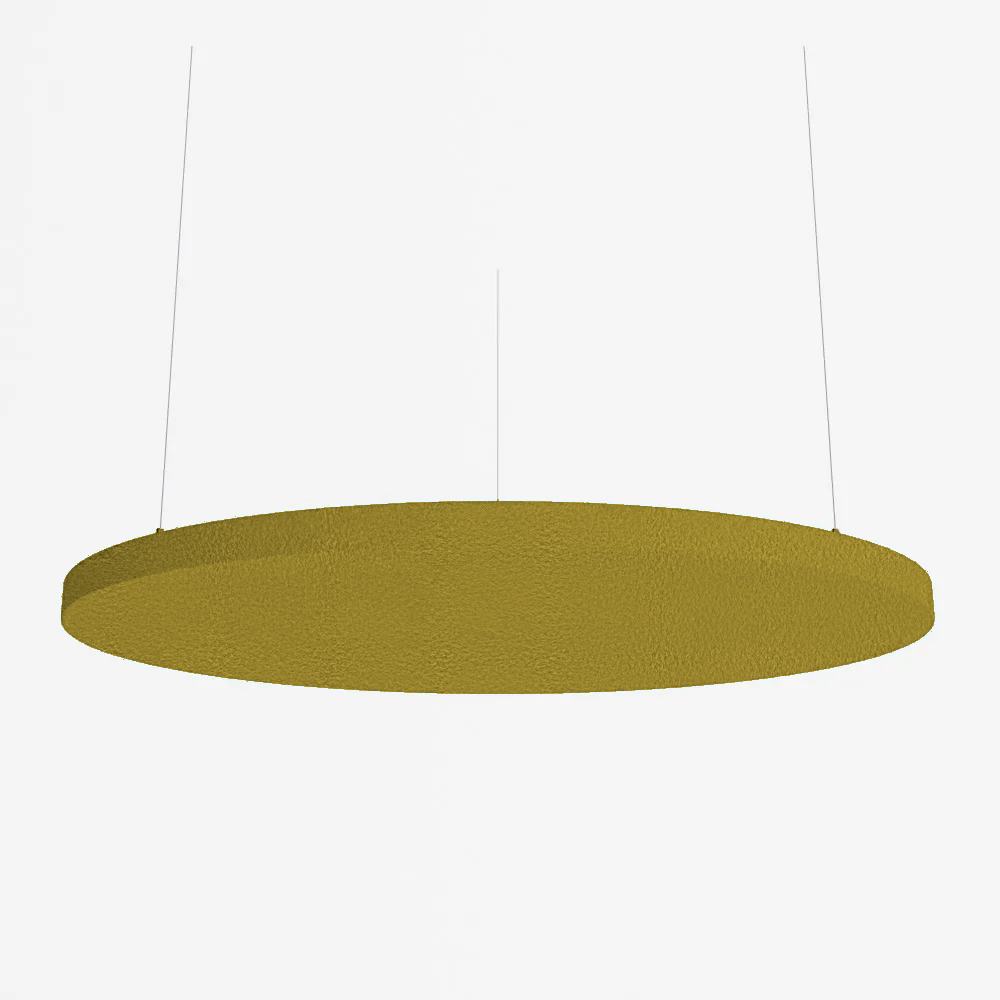
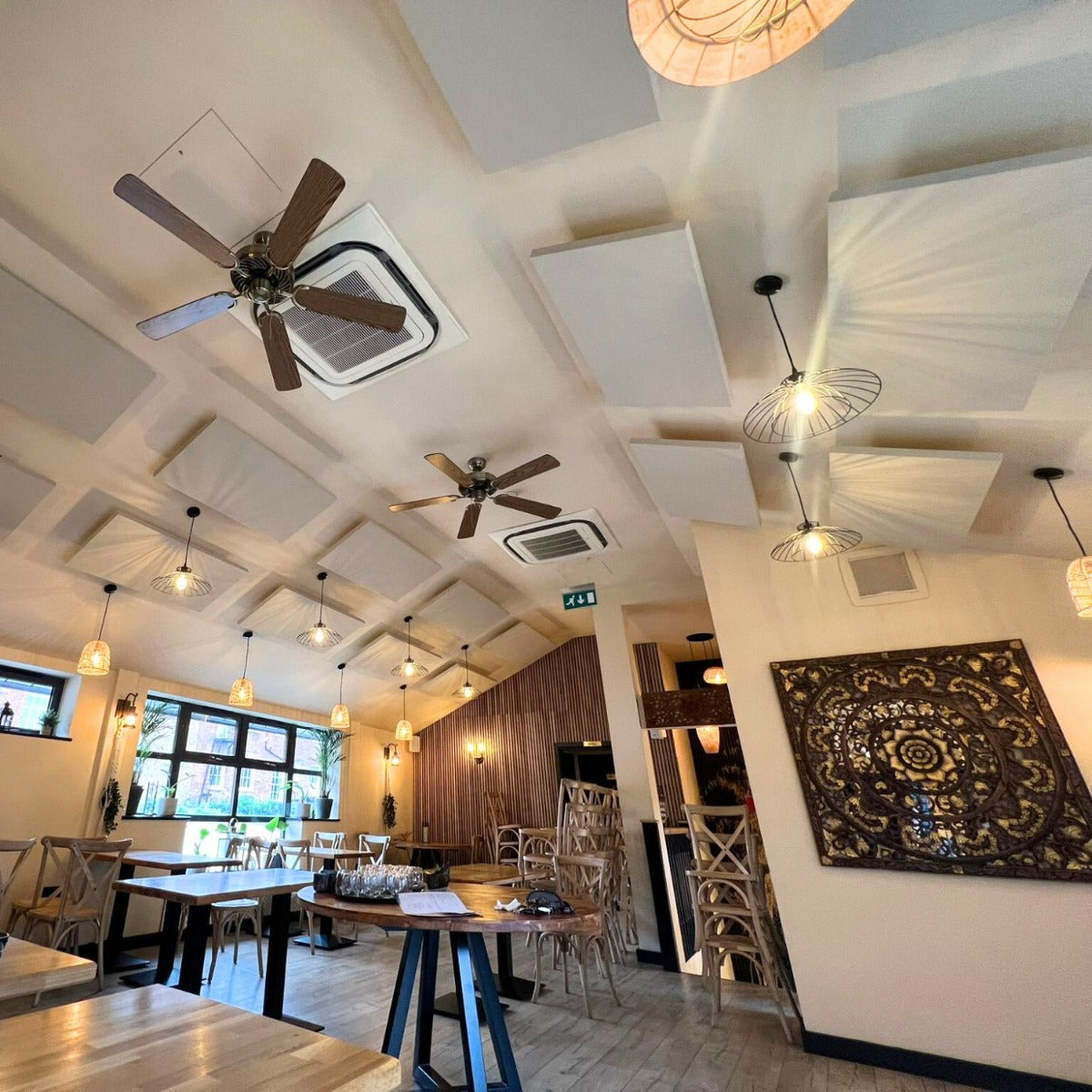
Fabric-wrapped acoustic panels work because the core does the heavy lifting and the fabric simply lets sound in without reflecting it. Our SilentSpace Fabric Wrapped Acoustic Ceiling Raft uses a 40mm core faced in Camira Sonus or Lucia fabric, and because it's suspended below the concrete soffit, it absorbs across both faces and its exposed edges.
That's a meaningful practical detail: a ceiling raft removes more total sound energy per square metre than a flat wall panel of the same size, because there's no wall behind it reflecting energy back.
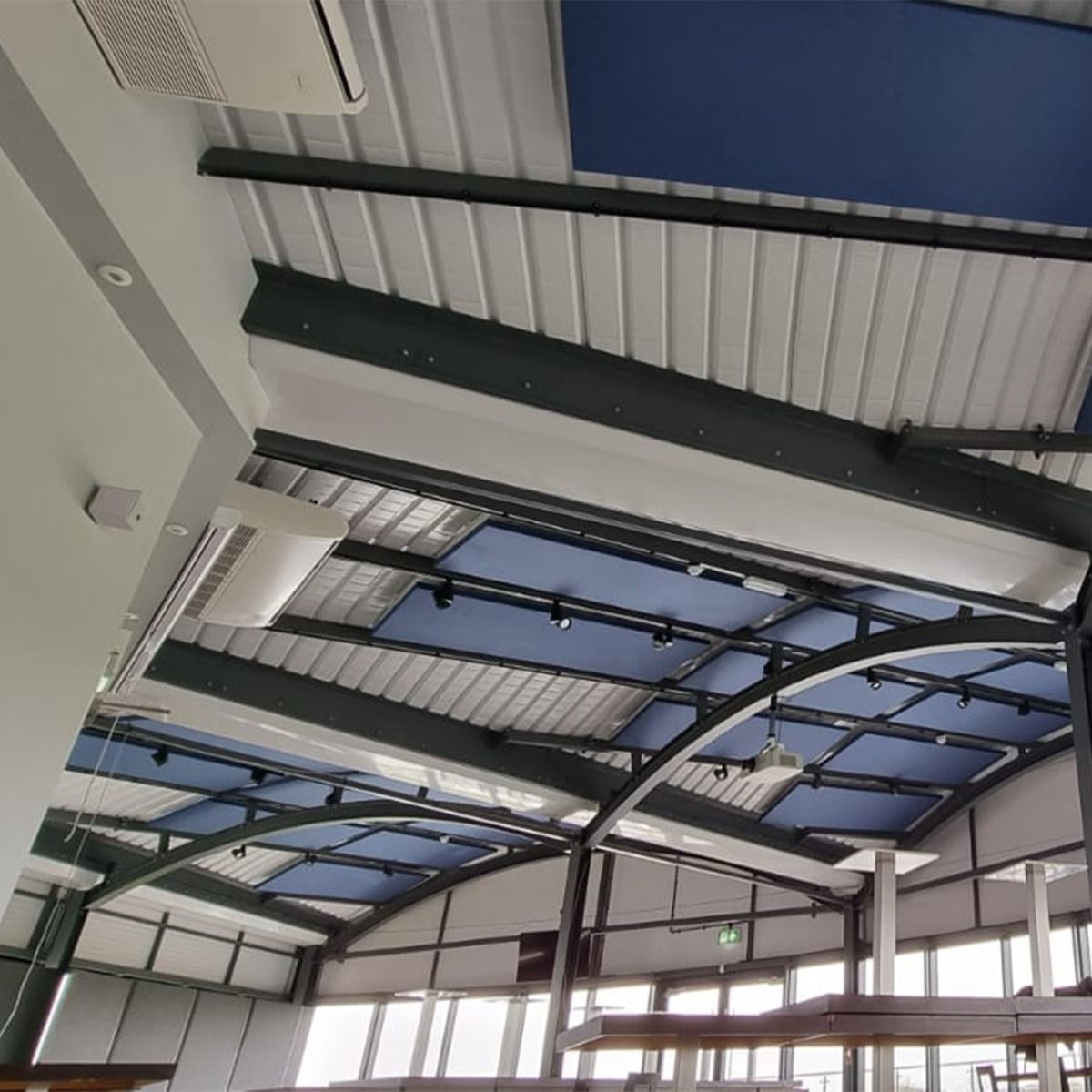
Baffles work on the same principle but hang vertically, which is useful when ceiling height is limited or you need to break up long, flat expanses of soffit without losing headroom. Both approaches deliver high αw performance because the fabric never gets in the way of absorption, it simply hides the core underneath a finish that suits the room.
How PET Felt Panels Work: Recycled Fibre and Its Acoustic Limits
PET acoustic panels are made from compressed recycled polyester fibre, often sourced from post-consumer plastic bottles, pressed into rigid or semi-rigid boards. The fibre structure traps sound in the gaps between strands, which works reasonably well at mid and high frequencies but tends to struggle with lower ones.
Standard acoustic foam and many entry-level PET boards only rate between 0.4 and 0.6 NRC, meaning they absorb just 40% to 60% of incoming sound rather than the near-total absorption fabric-wrapped mineral wool panels can achieve.
Did You Know?
Standard acoustic foam and many budget PET panels rate between just 0.4 and 0.6 αw, absorbing only 40% to 60% of incoming sound.
That doesn't make PET a bad choice. It makes it a specific one, better suited to spaces where speech clarity in the 500Hz to 2kHz range is the priority rather than deep bass control, and where the lighter weight and lower cost per square metre matter more than absolute absorption.
Fabric vs PET Acoustic Performance: Comparing NRC Ratings Side by Side
The clearest way to see the fabric vs PET acoustic gap is to look at NRC ratings across a typical product range rather than a single panel. Fabric-wrapped panels with a dense mineral wool core consistently land at the top of the scale, often rated 0.85 or higher, while PET felt boards vary more depending on thickness and density.

αw ratings show fabric panels can hit near-total absorption, while typical PET foam panels trail behind
A panel with an αw of 0.85, which is common across our fabric-wrapped range, absorbs 85% of the sound waves that strike it. That single figure explains why fabric wrapping tends to win out in rooms where reverberation time is the core problem, such as sports halls, open-plan offices, and double-height atriums.
Best Fabric-Wrapped Panels for Offices and Meeting Rooms
Open-plan offices are one of the clearest cases for fabric over PET, because the acoustic problem usually spans the full frequency range, not just speech frequencies. Reflections off desks, glass partitions, and hard ceilings compound quickly in a busy office, and a joined-up approach using both ceiling rafts and wall panels tends to outperform a single-surface fix.


The SilentSpace Circle Acoustic Panels (from £115.00) and the Fabric Wrapped Rectangle Acoustic Raft (from £145.00) both use the same fabric-wrapped construction, just in different silhouettes, so you can mix shapes on a single ceiling plan without mixing acoustic performance. For a deeper look at layout options, our guide on meeting room acoustic panels covers coverage ratios room by room.
Fabric Wrapped Wall Panels: Squares, Rafts, and Custom Shapes
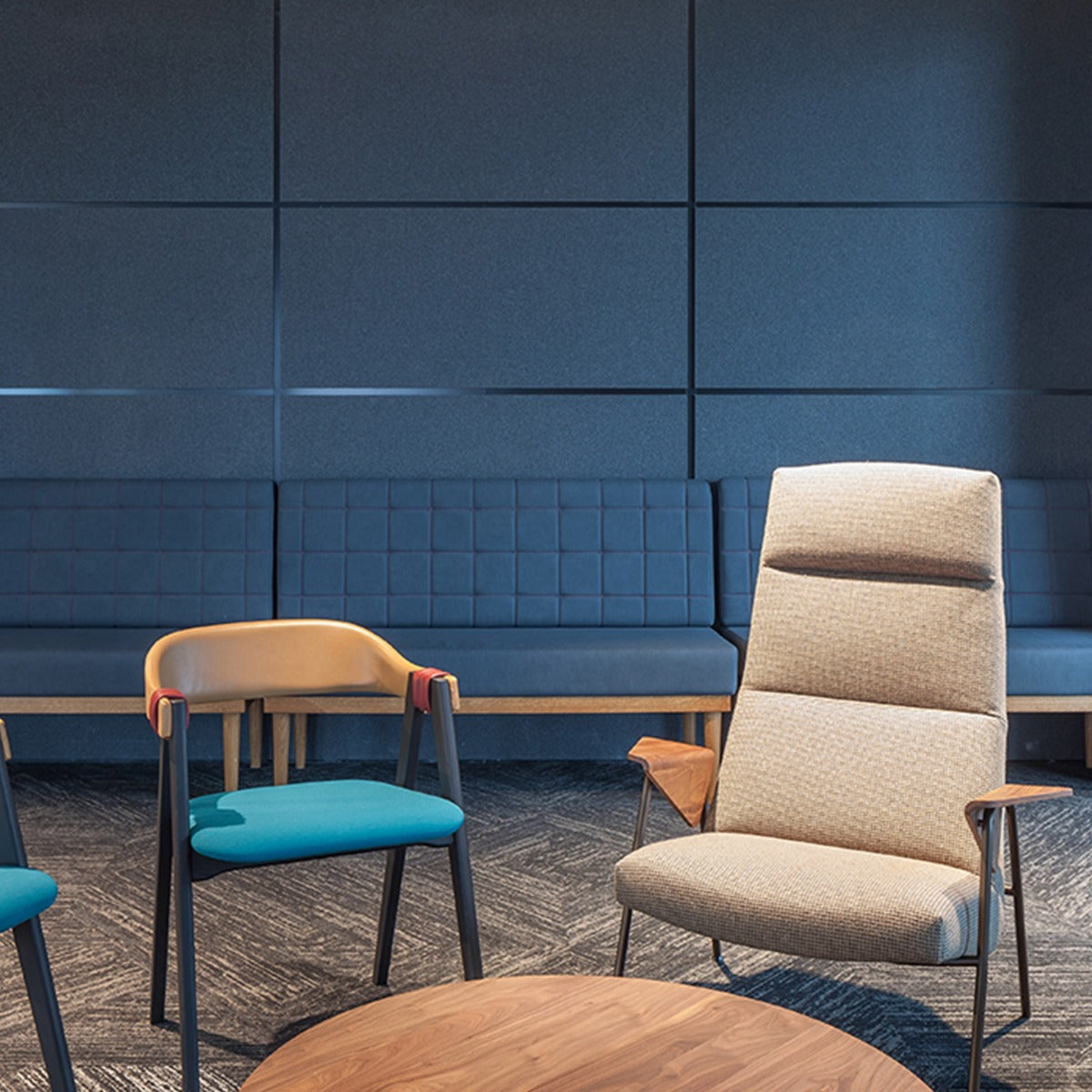
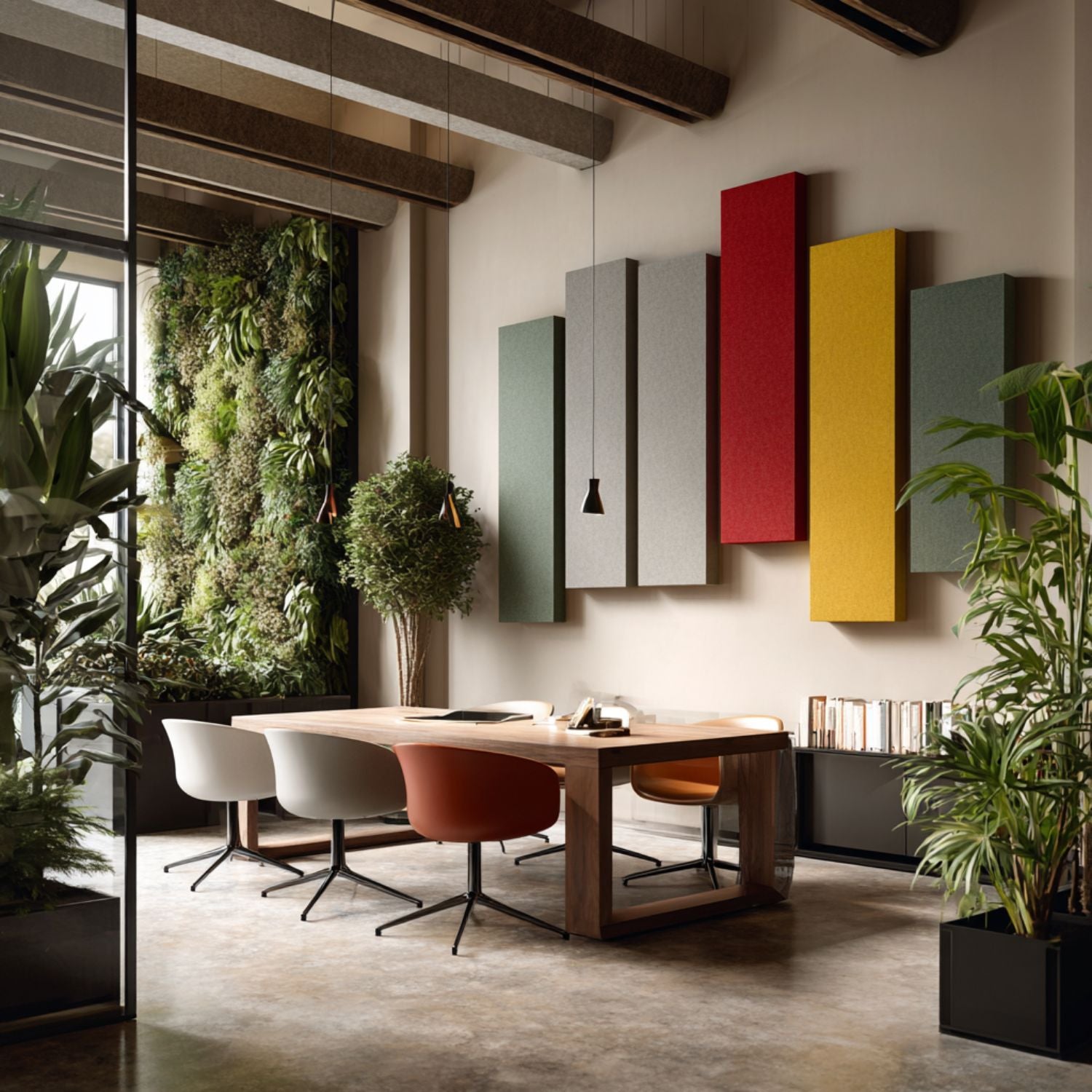
Wall-mounted fabric panels give you the same absorption performance as ceiling rafts, without needing suspension hardware or a clear ceiling void. That makes them the low-disruption retrofit option for tenanted offices or listed buildings where you can't touch the ceiling structure.

The Fabric Wrapped Square Acoustic Raft (from £99.95) ships in multiple sizes with installation fixings included, which keeps the total cost predictable rather than adding fixings as a separate line item later. Fabric options like Camira Sonus and Lucia let you match a colour scheme without compromising the αw rating underneath, since the acoustic performance sits entirely in the core, not the finish.
Where PET Acoustic Panels Still Make Sense
None of this means PET panels are the wrong choice. They're genuinely useful where weight, cost, or a specific decorative pattern matter more than maximum absorption, and where the room's biggest problem is speech clarity rather than deep reverberation.
A classroom with a modest ceiling height, a small meeting pod, or a corridor with light foot traffic often doesn't need 0.85+ αw treatment across every surface. PET's lighter weight also makes it easier to specify across very large wall or ceiling runs without loading the structure, and recycled polyester content supports sustainability targets that some organisations now require in a tender.
Our Autex Cube PET Acoustic Panel is a good example of the category done properly: a rigid, patterned PET board that's fast to install across large areas at a lower cost per square metre than fabric wrapping.
Durability and Long-Term Cost: Fabric vs PET Acoustic Panels Over Time
Acoustic treatment is a long-term investment, not a one-off decoration job, and durability is where fabric-wrapped panels often justify a higher upfront cost. Quality fabric panels routinely last 20 or more years without meaningful degradation in either appearance or absorption performance.
Budget foam and lower-grade PET options tell a different story. Cheap foam and thin felt boards can crumble, discolour, or lose structural integrity in as little as 2 to 3 years, especially in rooms with UV exposure or high humidity.
Did You Know?
Cheap foam and low-grade felt panels can crumble or discolour in just 2 to 3 years, while quality fabric-wrapped panels last two decades or more.
Fabric vs PET Acoustic: Which Should You Choose for Your Space?
The best choice depends on your room, your ceiling height, your budget, and the specific acoustic problem you need to solve. A church nave with a long reverberation tail and a lot of hard stone surface almost always calls for fabric-wrapped rafts and wall panels, because the goal is controlling low-frequency buildup as much as clarifying speech.
A home office or small pod, by contrast, might do everything it needs with PET panels at a fraction of the material cost. Our guide to the best acoustic panels for productive home offices breaks this down room type by room type, and our buyer's guide for churches does the same for larger, more reverberant spaces.
The fix is rarely to deaden the entire room. It's to treat the surfaces causing the worst reflection points, whichever material gets you there most efficiently.
Conclusion
When it comes down to fabric vs PET acoustic panels, the science is straightforward even if the decision isn't always simple. Fabric-wrapped panels deliver higher NRC ratings, longer working lives, and better performance across the full frequency range, which is why we specify them for offices, churches, and village halls where reverberation time is the dominant problem.
PET panels earn their place where weight, budget, or a specific pattern matter more than absolute absorption. Whichever direction you lean, browsing our acoustic wall panels collection is the fastest way to compare real αw figures, fabric options, and pricing before you commit to a spec for your space.
Frequently Asked Questions
Is fabric or PET better for acoustic panels?
Fabric-wrapped panels generally outperform PET on raw absorption, with αw ratings of 0.85 to 1.00 versus 0.40 to 0.60 for PET. Which is "better" depends on the problem: fabric earns its cost against genuine reverberation in hard-surfaced offices or halls, while PET does the job for less in smaller rooms where speech clarity is the main concern.
What's the actual cost difference between fabric and PET panels?
Based on our SilentSpace and Autex ranges, fabric-wrapped rafts run roughly £149 to £278 per square metre depending on panel size, while Autex Cube PET panels run a flatter £93 to £96 per square metre. Larger fabric panels bring the per-square-metre cost down significantly, since fixings and labour are spread over more area.
Can I mix fabric and PET panels in the same room?
Yes, and it's often the smart approach. A common spec pairs fabric-wrapped ceiling rafts for maximum overhead absorption with PET wall panels at eye level for a lighter finish and lower cost. Calculate total αw coverage across both surfaces together rather than treating each material separately.
Do PET panels need replacing sooner than fabric?
Budget PET and foam can degrade within 2 to 3 years, particularly with UV or humidity exposure. Better-quality PET boards last considerably longer than that, so the 2 to 3 year figure applies to entry-level products rather than the category as a whole.
Will either material stop noise from next door?
No. Both fabric and PET panels absorb sound within a room to reduce echo and reverberation, but neither blocks sound transmission between rooms. That requires a separate approach, such as acoustic plasterboard, sealed openings, or added mass, distinct from acoustic treatment.
How do I know how much coverage I need?
Coverage depends on room volume, existing hard surfaces, and your target reverberation time, not a fixed percentage. A starting point is 20-40%. An acoustic calculator can give a specific panel count based on your room dimensions rather than a general rule of thumb.


