












Search for "Class A fire rated acoustic panels" and you'll get thousands of results. Here's the problem: there is no Class A fire rating in the UK.
It's an American term from an American test. Specify against it here and you risk buying a panel that doesn't meet your building's actual requirement. This guide covers the classification that does apply — Euroclass, under BS EN 13501-1 — what Building Regulations actually demand, and which panels to use where.
Key Takeaways
- UK fire classification is Euroclass, under BS EN 13501-1. The scale runs A1, A2, B, C, D, E, F. There is no "Class A".
- "Class A" is a US rating (ASTM E84). It doesn't convert to Euroclass and won't satisfy Building Control on its own.
- Class 0 is dead. BS 476 reaction-to-fire classifications were withdrawn from Approved Document B for new building work from 2 March 2025.
- The minimum depends on the room, not the building. A small room needs D-s3,d2; a corridor needs B-s3,d2.
- B-s1,d0 is the best-practice baseline most commercial projects now specify, comfortably above the regulatory minimum.
- There's a second, unrelated Class A — sound absorption class under EN ISO 11654. Always ask which one a supplier means.
- Fire rating says nothing about acoustics. Painted plasterboard is non-combustible and absorbs almost nothing.
The Euroclass Scale, Top to Bottom
BS EN 13501-1 classifies how much a product contributes to a fire. Seven levels, best to worst:
A full classification also carries smoke and droplet suffixes — written as B-s1,d0. Both matter as much as the letter.
Smoke production
Smoke destroys visibility during evacuation.
-
s1Little to no smoke -
s2Limited smoke production -
s3No restriction on smoke
Flaming droplets
Burning droplets spread fire downward and ignite what's below.
-
d0No flaming droplets -
d1Limited droplets -
d2No restriction on droplets
EN ISO 11654 grades sound absorption from A to E, where Class A means a weighted absorption coefficient (αw) of 0.90 or above. A panel can be Class A for absorption and Euroclass D for fire. The two say nothing about each other. If a supplier quotes "Class A" without naming the standard, ask which.
What Approved Document B Actually Requires
Acoustic panels fixed to walls or ceilings are internal linings under Requirement B2 of Approved Document B (Volume 2). The minimum classification depends on the room's function, not the building type:
| Location | Minimum classification | Why |
|---|---|---|
| Small room (≤30m²) | Lower risk of large-scale fire spread | |
| Other rooms | Larger volume needs better surface flame control | |
| Circulation spaces (corridors, lobbies, stairways) |
These are escape routes and need the highest protection |
This is the detail most buyers miss: a panel that's perfectly compliant in a classroom may not be acceptable in the corridor outside it. Confirm the requirement zone by zone.
Minimum compliance isn't best practice. Most commercial projects now specify B-s1,d0 as a baseline and A2-s1,d0 for high-occupancy or higher-risk environments — driven by insurer requirements, corporate risk policy and fire engineer recommendations. Note that the regulatory minimums above allow s3 and d2, meaning unrestricted smoke and droplets. Specifying s1,d0 closes that gap.
Why Class 0 and ASTM E84 Don't Cut It
Class 0 was the old British benchmark for surface linings, from BS 476 Parts 6 and 7. It measured surface flame spread but never the combustibility of a product's core — which is exactly how combustible cladding achieved it. Following Grenfell, the national classifications were removed from Approved Document B, and from 2 March 2025 a Class 0 rating alone no longer satisfies Building Control for new work.
ASTM E84 is the US equivalent and appears constantly on internationally sourced products. It's a legitimate test — just not a UK one, and there's no reliable conversion between the two systems. If a datasheet shows only ASTM E84, treat the product as unclassified until you see BS EN 13501-1 documentation.
You may also see B1 on European datasheets. That's the German DIN 4102 system, not Euroclass. B1 is not the same as B-s1,d0 and shouldn't be quoted as if it were. Ask for the BS EN 13501-1 classification report.
How Different Materials Perform
Material choice largely determines the classification you can reach:
| Material | Typical classification | Best suited for |
|---|---|---|
| Mineral fibre / wood wool cement | Circulation spaces, stairways, high-occupancy environments | |
| Glass wool | Offices, schools, public buildings, suspended ceilings | |
| PET (recycled polyester) | Offices, meeting rooms, education, general commercial | |
| Fabric-wrapped systems | (system dependent) | Feature walls, meeting rooms, hospitality |
| Timber — untreated | Low-risk rooms only | |
| Timber — fire-retardant treated | Offices and meeting rooms | |
| Polyurethane acoustic foam | Rarely suitable — never on escape routes |
Two things worth flagging. First, fabric-wrapped panels are classified as a complete system, not by their core — a non-rated decorative fabric will pull down an otherwise compliant panel. Second, fire-retardant treatments are not permanent. Sprays typically last one to five years and may need reapplication, so always request the classification report and confirmation of maintenance requirements.
Standard Office and Retail Walls
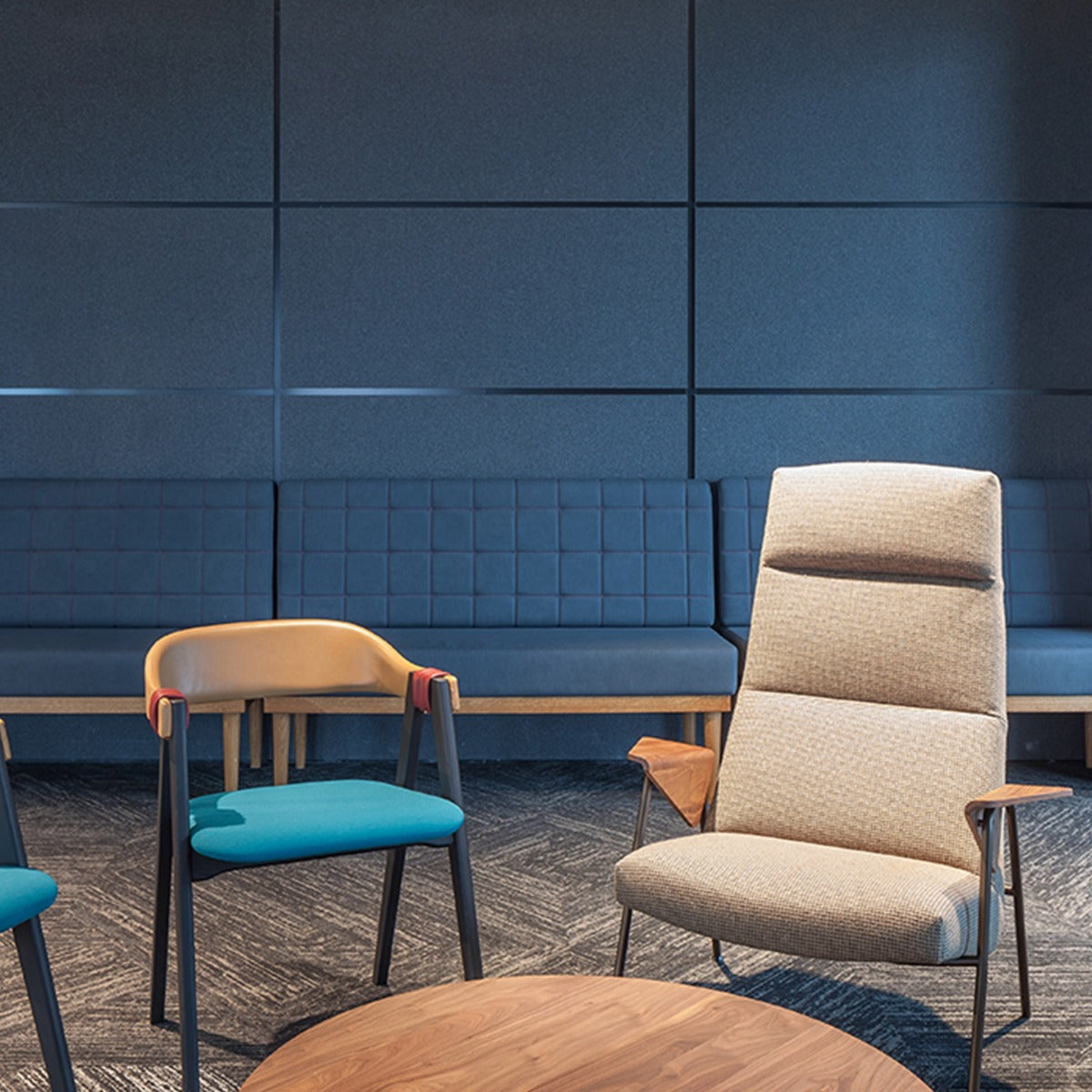
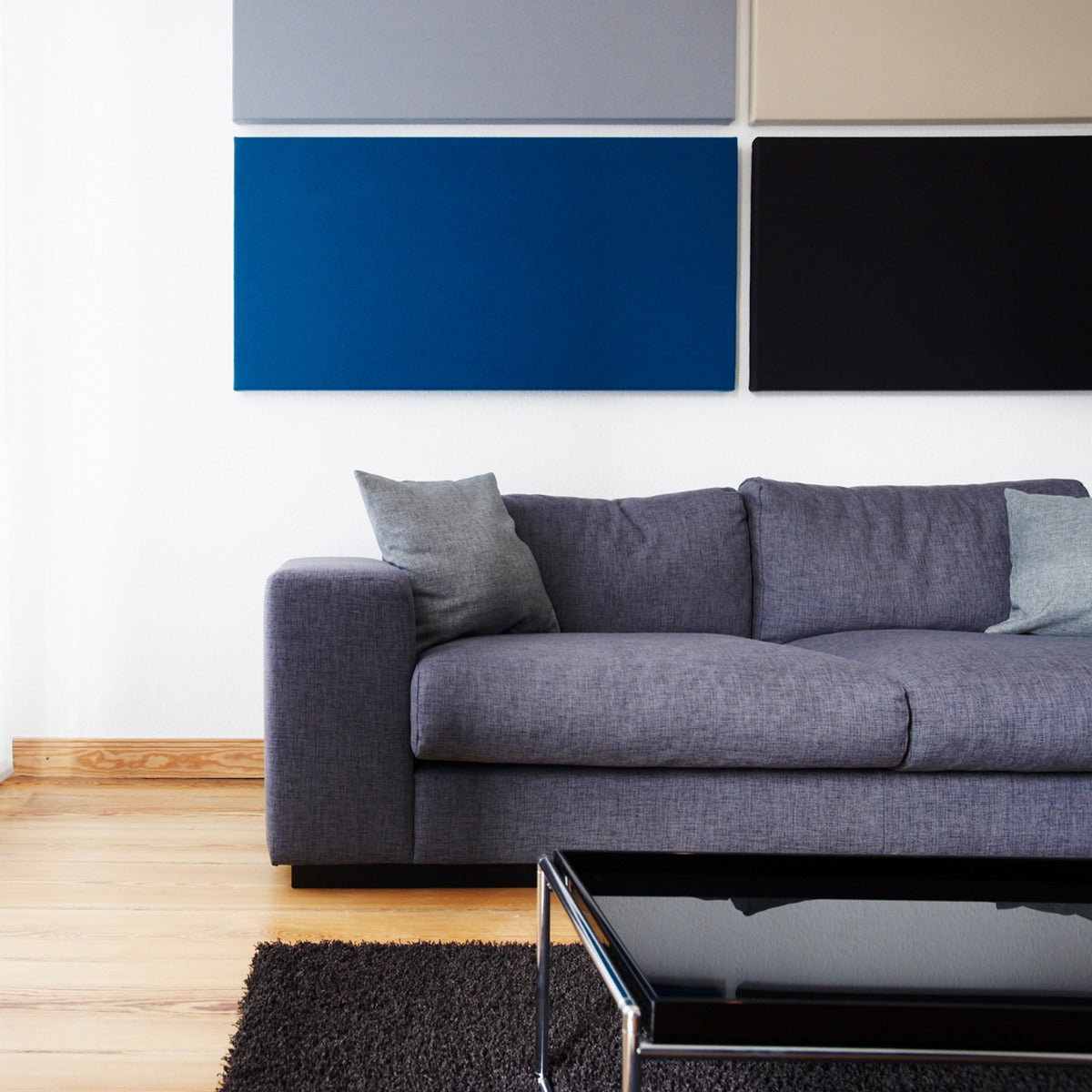
For general commercial walls you're absorbing the mid and high frequencies that wreck speech clarity. A modular fabric-wrapped panel on a mineral or glass wool core is the straightforward answer.
SilentSpace Square
- From £45.68
- 40mm
- Absorption Class A
- B-s1,d0
The panel we recommend most often for a fast, low-disruption retrofit across a large plain wall. Wrapped in Camira, Maharam, Kvadrat or Gabriel — and because the fabric carries its own rating, every fabric we stock is specified with its own test data.
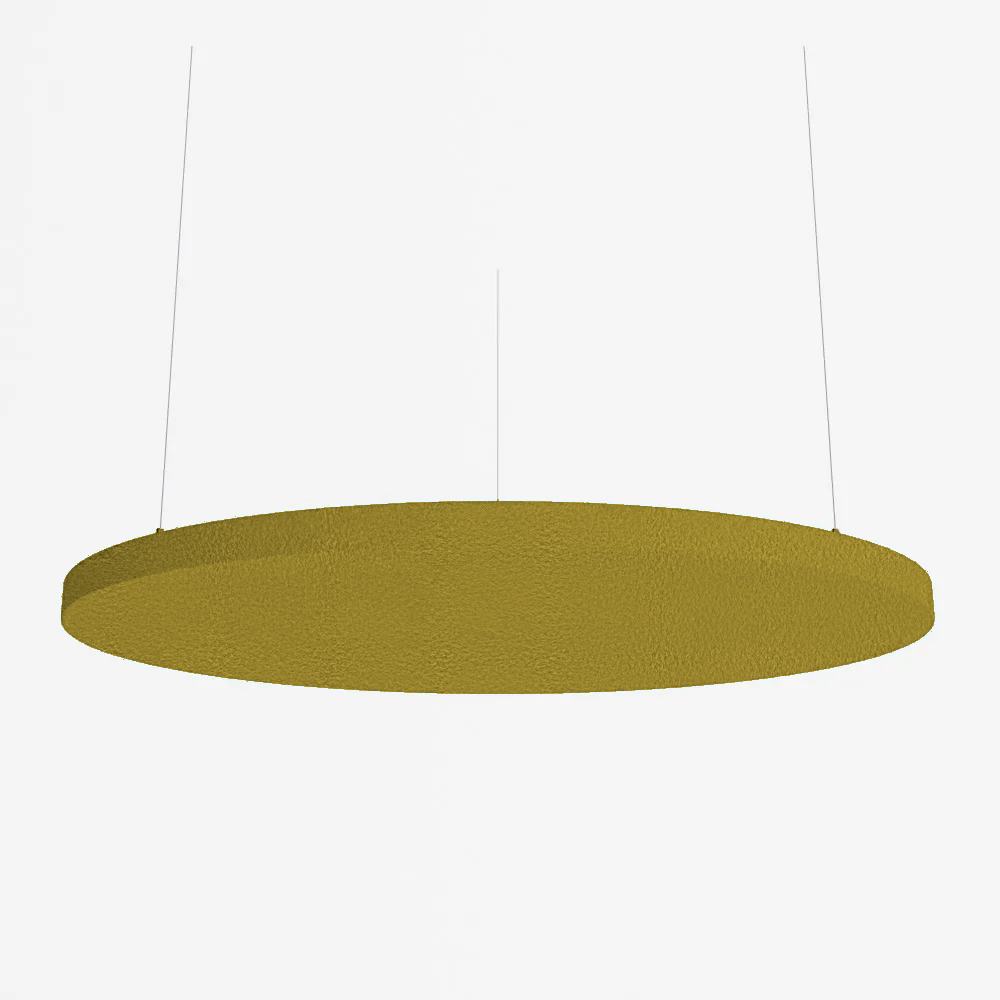
SilentSpace Circle
- From £115.00
- 40mm
- Absorption Class A
- B-s1,d0
The same construction and absorption class in a softer geometric format, for schemes where the panel layout is part of the interior rather than hidden behind furniture.
Browse fabric wrapped acoustic wall panels
Schools, Sports Halls and High-Traffic Buildings
A standard fabric panel won't survive a stray basketball or a corridor full of moving furniture. Different problem, different product.
SilentSpace High-Impact Square
- £65.00 per panel
- Impact tested
- Absorption Class A
- B-s1,d0
Class A absorption with independently tested impact resistance. Spikes and adhesive included, and the modular grid means a damaged panel gets swapped individually rather than replacing a wall.
For school projects, note that BB 100 (Design for Fire Safety in Schools) may apply alongside Approved Document B, and corridors will need to meet the circulation-space requirement rather than the room one.
Wood Wool for Natural, Textured Interiors
BAUX Diagonal RH
- £105.72
- Wood wool
- Matching LH available
- B-s1, d0
Tested to BS EN 13501-1. The open wood wool structure absorbs well across the mid and high frequencies, and a matching LH panel is available for symmetrical tiling — which matters more than it sounds across a large feature wall.
A realistic note on frequency: no 25–40mm panel of any material does much below about 250Hz. Low-frequency absorption is a function of thickness and air gap, not material type. If you have a genuine low-end problem you need depth behind the panel, and that's worth a conversation rather than a product page.
Recycled PET for Design-Led Interiors
Autex Cube
- £285.00 per sheet
- 2440 × 1220mm
- Two thicknesses
- 12mm B-s1, d0 24mm B-s2,d0
Usable as full wall covering or cut to bespoke shapes without losing acoustic performance. Certification supplied with every order.
Custom Fabric Wraps
SilentSpace Custom Fabric-Wrapped
- From £99.95
- Camira / Maharam / Kvadrat / Gabriel
- B-s1, d0
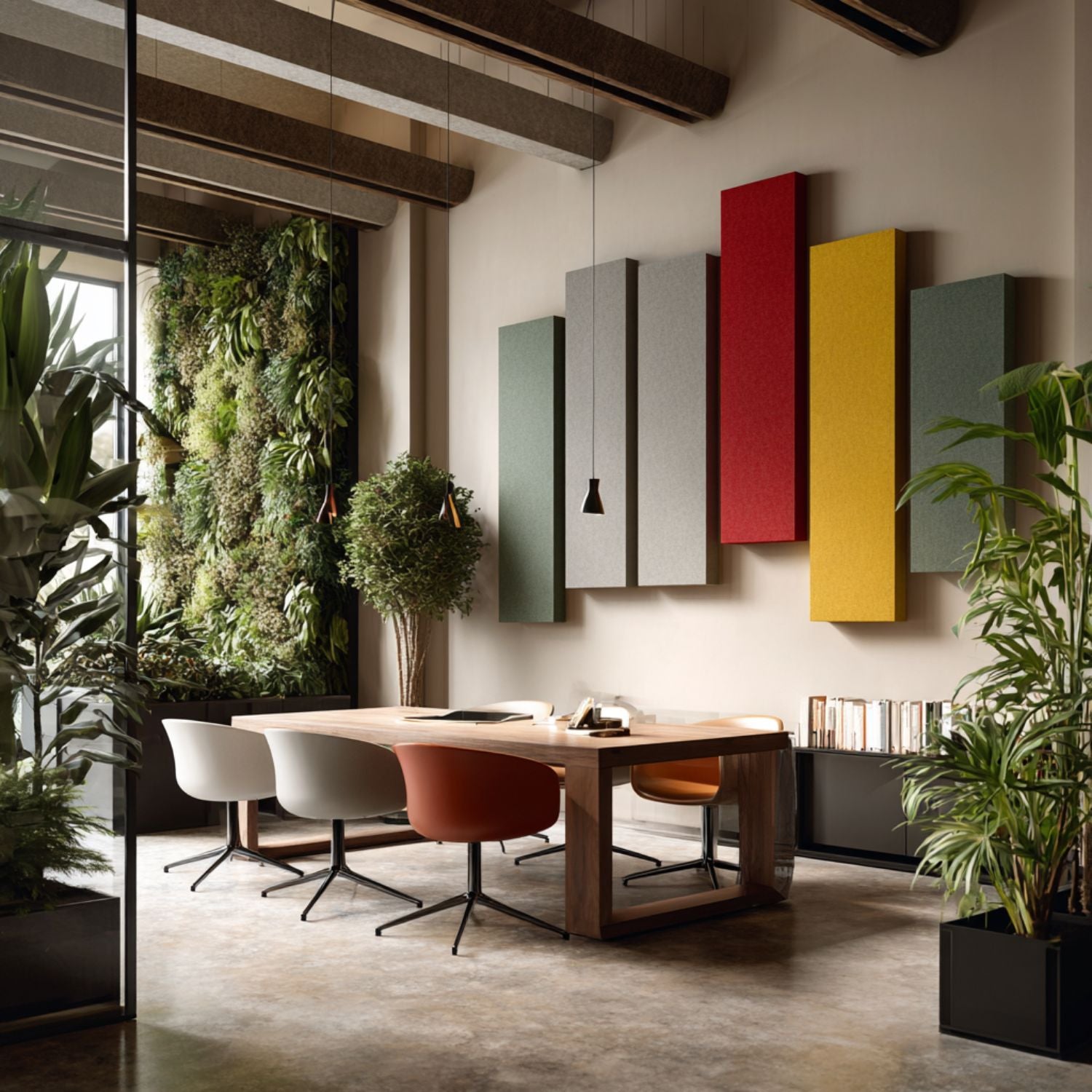
Nearly any fabric over the same tested core. Because the classification applies to the finished system, we'll confirm the combined figure for your chosen fabric before the order goes into production.
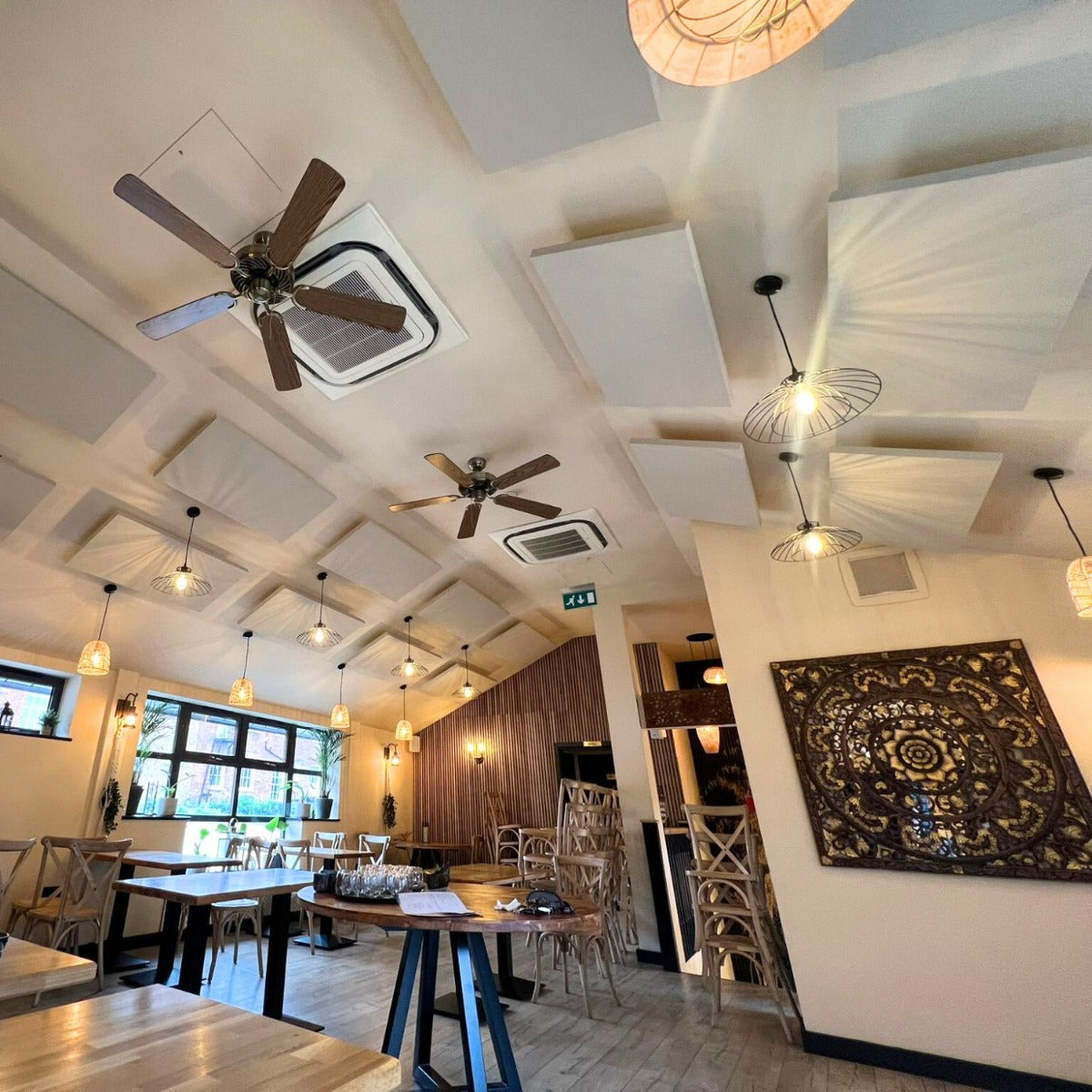
For ceilings rather than walls, the SilentSpace rectangle acoustic raft suspends the same tested core above the room, absorbing across both faces at once. Rafts are classified differently to flat wall panels because both faces are exposed — always check the certification covers your mounting method.
Fire Rating Tells You Nothing About Acoustics
This is the trap. Painted plasterboard is non-combustible and absorbs roughly 5% of the sound hitting it. A room specified purely for fire compliance is still a room full of hard, reflective surfaces.
Good acoustic panels sit at αw 0.70 to 0.95 — absorbing 70% to 95% of incident sound energy. That's the number doing the actual work. The fire classification is what makes it legal to put on the wall. Two separate specifications, both required.
Our acoustic calculator takes about two minutes and gives you a realistic coverage figure and working budget before you talk to anyone.
Four Questions Before You Specify
- What's the room's function? Classification is set by room type, not building type. Circulation routes are stricter than the rooms they serve.
- Wall, ceiling, or both? Rafts and baffles are certified differently to flat panels because both faces are exposed.
- High-traffic or low-traffic? Impact resistance is a separate requirement layered on top of fire performance.
- What's the current reverberation time, and what's the target? That determines how much absorption you actually need.
Sonio is the direct arm of Resonics, an acoustic treatment specialist established in 2013 and based in Deptford, London, with over 7,000 completed projects. Their full technical guide to acoustic panel fire ratings goes deeper on testing methodology and material behaviour. For project-specific fire compliance, always consult a qualified fire engineer.
Frequently Asked Questions
Is there such a thing as a Class A fire rated acoustic panel in the UK?
No. "Class A" is a US fire rating from ASTM E84. UK products are classified under BS EN 13501-1 as A1, A2, B, C, D, E or F. Confusingly, "Class A" does exist in the UK as a sound absorption class under EN ISO 11654 — which is why the term causes so much confusion. Always ask a supplier which standard they're quoting.
What Euroclass do acoustic panels need?
It depends on the room. Under Approved Document B, small rooms up to 30m² need D-s3,d2, other rooms need C-s3,d2, and circulation spaces such as corridors and stairways need B-s3,d2. Most commercial projects now specify B-s1,d0 as a best-practice baseline, with A2-s1,d0 in high-occupancy or higher-risk environments.
What do s1 and d0 mean in a fire rating?
They're smoke and droplet ratings. The s value covers smoke production, from s1 (little to no smoke) to s3 (no restriction). The d value covers flaming droplets, from d0 (none) to d2 (no restriction). B-s1,d0 is the best combined result achievable for most organic materials.
Is Class 0 still valid in the UK?
Not for new work. Class 0 came from the BS 476 series, which was removed from Approved Document B for reaction to fire from 2 March 2025. It measured surface flame spread but never core combustibility. If a product only holds a Class 0 rating, ask for BS EN 13501-1 documentation.
Are fabric-wrapped acoustic panels fire safe?
They can be, but classification applies to the complete system, not the core alone. A mineral or glass wool core will typically perform well, while a non-rated decorative fabric over it can pull the combined classification down — fabric choice particularly affects the smoke rating. Always specify fire-rated fabrics where smoke control matters.
Is acoustic foam fire rated?
Usually poorly. Standard polyurethane acoustic foam frequently sits at Euroclass C or D and is rarely suitable for escape routes without specialist treatment. Tested cores — mineral wool, glass wool, wood wool, certified PET — are the appropriate choice for commercial and public buildings.
Do fire-retardant treatments last?
Not indefinitely. Fire-retardant sprays on timber and fabric systems typically last one to five years, and performance depends on correct application and maintenance. Reapplication may be required. Always request a BS EN 13501-1 classification report plus confirmation of maintenance requirements.
How much do fire rated acoustic panels cost?
From around £45.68 for a SilentSpace square fabric panel up to £285.00 for a full Autex Cube PET sheet. Impact-resistant and custom fabric options generally sit between £65 and £115 per panel. Prices shown are current at the time of writing.


