








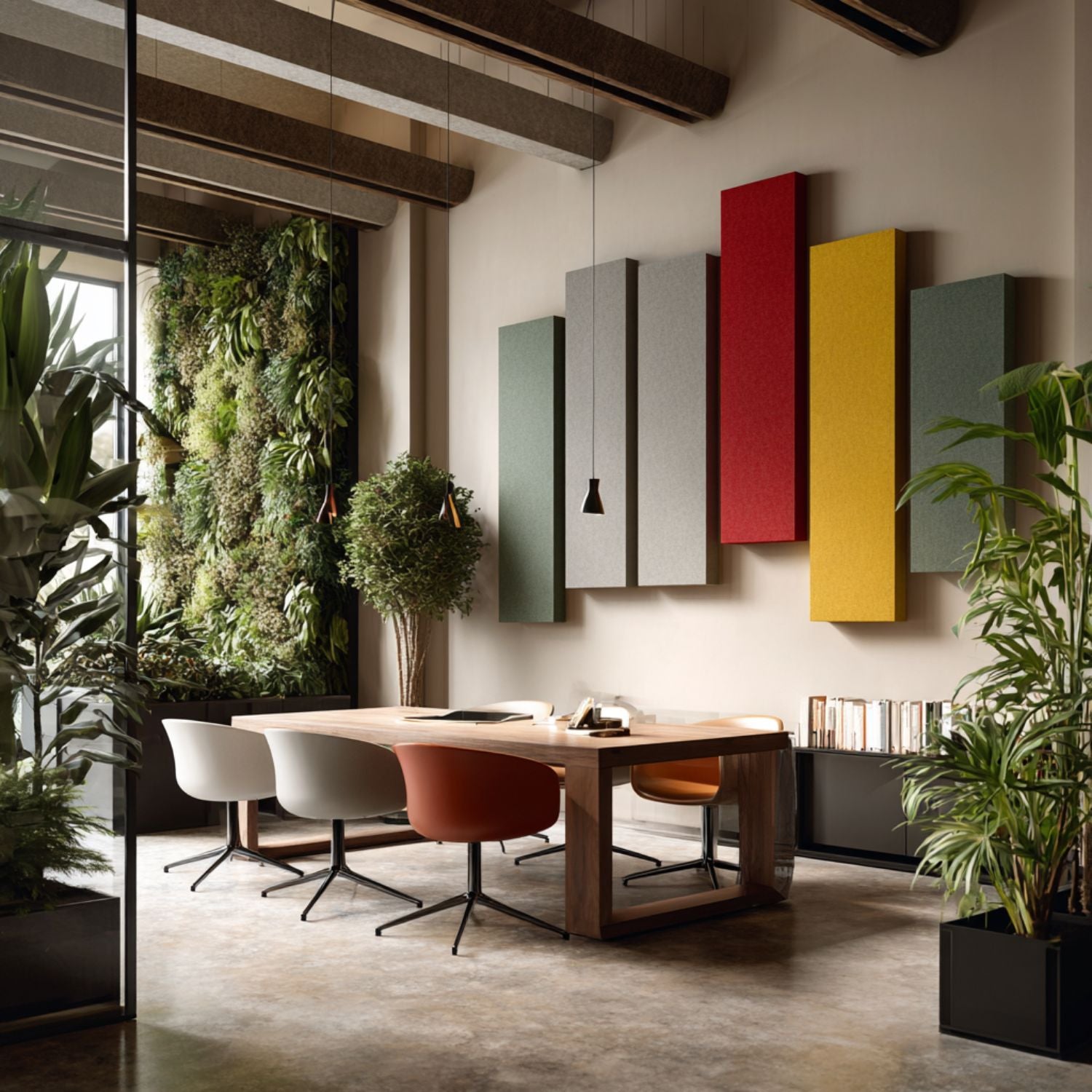
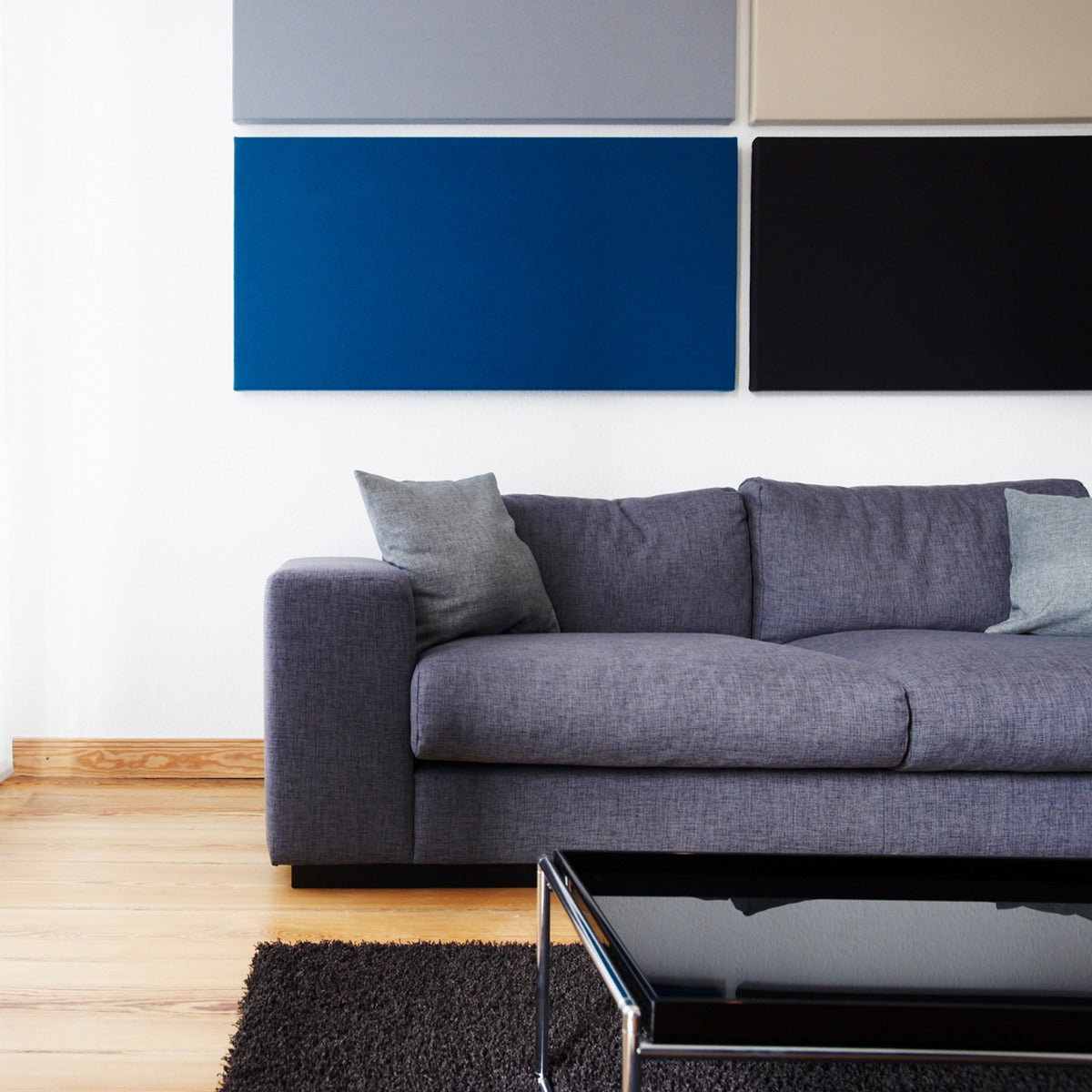


How Many Panels do I Need?
We've developed a simple calculator to assist you with calculating the current reverb time within your space, and the impact acoustic panels can have.
Why every space has its own "sound signature"
Walk into a busy restaurant and you'll know immediately whether you can hear the person sitting across the table. Step into a meeting room and you'll know within seconds whether a conference call is going to be exhausting. That's not coincidence — it's reverberation time at work.
Reverberation time, or RT60, is how long it takes for sound to fade away in a room. A short reverberation time means sound dies away quickly, which gives you clarity — ideal for offices, classrooms, and meeting rooms where speech needs to be understood. A long reverberation time means sound lingers and overlaps, which is fine for cathedrals and concert halls but exhausting in everyday spaces.
The good news is reverberation is one of the easiest acoustic problems to fix. Adding the right amount of sound-absorbing material — acoustic wall panels, ceiling rafts, or hanging baffles — can transform a space in a single afternoon. The challenge is working out how much you actually need.
How the calculator works
Our acoustic calculator uses the Sabine equation, the same formula acoustic engineers have used since 1898 to predict reverberation. It looks at your room's volume and the absorption properties of every surface inside it (floor, walls, ceiling, doors, windows) and works out how long sound takes to decay.
You then choose acoustic panels from our SilentSpace, Ecophon, and Autex ranges, set how much of your wall or ceiling area you want to cover, and the calculator shows your new reverberation time alongside a clear recommendation of which products to order and in what quantity.
The thresholds the calculator uses are taken directly from Resonics, our sister company and the UK's leading acoustic installation specialist, drawn from over a decade of in-field acoustic treatment work across offices, schools, restaurants, and public buildings.
What "good" looks like
A few rules of thumb based on the Resonics guidance built into the calculator:
- Under 0.4 seconds: the target for AV/VC rooms and hearing-sensitive teaching spaces — very clear, almost studio-like.
- 0.4 to 0.6 seconds: excellent for enclosed offices, meeting rooms, primary classrooms, and home offices where speech clarity is the priority.
- 0.5 to 0.8 seconds: the right range for open-plan offices, restaurants, libraries, dining rooms, and call centres — controlled but natural.
- 0.8 to 1.2 seconds: appropriate for assembly halls, churches, village halls, and speech-led auditoria.
- Above 1.5 seconds: only appropriate for specific large-volume uses like swimming pools and sports halls — for any everyday space, this signals the room needs treatment.
Coverage matters more than panel count
A common mistake is to think about acoustic treatment in terms of "how many panels can I afford?" rather than "how much surface area do I need to cover?". A single Class A panel covering 5 m² will outperform ten Class D panels covering the same area — the absorption coefficient (NRC) of the panel matters far more than the visual count.
As a starting point, 20% to 40% coverage of one major surface (typically a wall or the ceiling) is usually enough to bring most rooms into the recommended range. The calculator below lets you experiment with different coverage levels and panel types in real time.
Acoustic Calculator
Estimate your room's reverberation time before and after acoustic treatment, and see what a difference the right panels can make.
Room dimensions
Enter the length, width and height of the room, plus the total area of any doors and windows. We'll work out the rest.
Your room at a glance
What is the room made of?
The materials on your floor, walls, ceiling, doors and windows determine how much sound is absorbed — and how much bounces around. We've pre-selected typical defaults — adjust them to match your room.
Apply Sonio acoustic treatment
Choose a wall panel or ceiling raft from our range, then pick how much of each surface to cover. 30%–50% coverage is usually enough to make a real difference.
Wall treatment
Ceiling treatment
Your acoustic results
Recommended reverberation times by space
Different spaces need different acoustic conditions. These target ranges come from Resonics — our sister company and the UK's leading acoustic installation specialist — based on over a decade of acoustic treatment projects across offices, schools, restaurants, and public buildings.
| Room type | Suggested RT |
|---|---|
| Open plan office | 0.5 – 0.8 seconds |
| Enclosed office | 0.4 – 0.6 seconds |
| Meeting room | 0.4 – 0.6 seconds |
| AV / VC room | 0.3 – 0.4 seconds |
| Primary / nursery classroom | 0.4 – 0.6 seconds |
| Secondary school classroom | 0.5 – 0.7 seconds |
| SEN / hearing-sensitive teaching space | < 0.4 seconds |
| Lecture hall | < 0.8 seconds |
| Theatre / auditorium (speech-led) | 0.8 – 1.2 seconds |
| Theatre / auditorium (music-led) | 1.2 – 1.6 seconds |
| Assembly hall | 0.8 – 1.0 seconds |
| School corridor / stairwell | < 1.5 seconds |
| Dining room / canteen | 0.6 – 0.8 seconds |
| Restaurant | 0.6 – 0.8 seconds |
| Church / village hall | 0.8 – 1.2 seconds |
| Library | 0.6 – 0.8 seconds |
| Swimming pool | 1.5 – 2.0 seconds |
| Call centre | 0.4 – 0.8 seconds |
| Cinema | 0.4 – 0.8 seconds |
| Sports hall | < 1.5 seconds |
These figures are the Resonics recommended ranges for achieving acoustic comfort and clarity, developed from a decade of in-field acoustic treatment work. Exact targets vary by room size and use. Read the full Resonics Guide to Reverberation Time for more detail, or request a free acoustic survey from the Resonics team.
Worked examples: how many panels for your space?
Four typical scenarios showing how reverberation time changes when you treat a room with the right products. The figures come from the same Sabine calculations the calculator above uses, with realistic absorption coefficients for each surface.
A 12 m² home office
Room: 4m × 3m × 2.4m, with a wood floor, plaster-on-brick walls, a plasterboard ceiling, one solid-core door (1.8 m²), and one double-glazed window (1.5 m²).
Before treatment: approximately 1.5 seconds — well above the recommended 0.4 to 0.6 seconds for focused work. Speech sounds echoey on calls, and concentrated reading or thinking feels harder than it should.
Recommended treatment: approximately 25% wall coverage with SilentSpace Square panels (40mm, Class A). That's around 7.5 m² of panels — for example, 5 SilentSpace Square 1.2 × 1.2m panels (totalling 7.2 m²), or 21 of the 0.6 × 0.6m size for a more graphic, mosaic look.
After treatment: approximately 0.5 seconds — squarely in the optimal range for a focused work space. Calls become more intelligible, recorded video sounds more professional, and concentration noticeably improves.
A 30 m² meeting room
Room: 6m × 5m × 2.7m, with a carpet tile floor, plaster-on-brick walls, a plasterboard ceiling, one solid-core door (2 m²), and one large single-glazed wall (8 m²).
Before treatment: approximately 0.95 seconds — well outside the 0.4 to 0.6 second target for meeting rooms. Group discussions feel busy, and people sitting at the far end of the table are harder to hear on hybrid calls.
Recommended treatment: ceiling treatment is usually the most effective option for meeting rooms because it doesn't compete with wall-mounted whiteboards or screens. Try 40% ceiling coverage with Ecophon Solo Square rafts (40mm, Class A) — that's roughly 12 m² of panel area, or 4 to 5 packs of two.
After treatment: approximately 0.55 seconds — within the meeting-room target. Speech intelligibility on conference calls noticeably improves, and meeting fatigue is reduced.
An 80 m² restaurant
Room: 10m × 8m × 3m, with a tiled floor, plaster-on-brick walls, a plasterboard ceiling, a solid-core door (2.5 m²), and large single-glazed windows (10 m²).
Before treatment: approximately 3.2 seconds in the empty room — far above the 0.6 to 0.8 second range now recommended for restaurants. (Diners, furnishings and soft fittings absorb some sound, but a hard shell like this stays uncomfortably loud even when full.) Diners report having to raise their voices, staff get fatigued, and the atmosphere tips from "lively" to "shouty" at peak times.
Recommended treatment: a mixed approach works best in hospitality — Autex Cube 24mm wall panels at around 25% coverage (decorative as well as functional, available in 20+ colours) combined with Ecophon Solo Circle 1200mm ceiling rafts at around 35% coverage. That's approximately 24 m² of wall panels (8 panels) and 28 m² of ceiling rafts (6–7 packs of 4).
After treatment: approximately 0.75 seconds — within the recommended range, with a measurable improvement in conversation comfort and a lower-stress environment for both customers and staff.
A 50 m² classroom
Room: 8m × 6.25m × 2.7m, with vinyl flooring, plaster-on-brick walls, a plasterboard ceiling, two hollow-core doors (3.6 m²), and three single-glazed windows (6 m²).
Before treatment: approximately 2.5 seconds — far outside the 0.4 to 0.6 second target for primary classrooms (0.5 to 0.7 seconds for secondary), and well beyond the BB93 requirement of 0.6 seconds for new-build primary teaching spaces.
Recommended treatment: classrooms benefit hugely from ceiling treatment because it doesn't interfere with display walls or whiteboards. SilentSpace Rectangle Rafts at 60% ceiling coverage — approximately 30 m² of panels — using 1.2 × 2.4m rafts (10 to 11 panels) for a clean, repeating layout.
After treatment: approximately 0.6 seconds — on target for primary settings and comfortably within the s


Frequently asked questions
How does the Sonio acoustic calculator work?
The calculator uses the Sabine equation — the standard formula used by acoustic consultants worldwide — to estimate your room's reverberation time based on its dimensions and the materials covering each surface. It then lets you simulate adding our acoustic panels at different coverage levels, showing how the reverberation time changes and which products to order.
How accurate are online acoustic calculators?
Online calculators using the Sabine equation are typically accurate to within around 15–20% for rectangular rooms with normal proportions. They're an excellent guide for sizing acoustic treatment for offices, classrooms, restaurants, and similar spaces. For complex shapes, very large volumes, or compliance-critical applications, a full survey by an acoustic specialist (such as our sister company Resonics) gives a more precise result.
How many acoustic panels do I need for a home office?
For a typical home office of 10–15 m², around 30% wall coverage with Class A panels is usually enough to bring reverberation into the recommended 0.4–0.6 second range. That's typically 6–9 m² of panel area, depending on room size. The calculator on this page will give a precise recommendation based on your exact room dimensions.
How many acoustic panels do I need for a classroom?
Classrooms typically need 40–60% ceiling coverage to meet BB93 acoustic standards (0.6 seconds for new-build primary settings, 0.8 seconds for secondary) — Resonics's 2026 guidance recommends 0.4–0.6 seconds for primary and 0.5–0.7 seconds for secondary classrooms, with under 0.4 seconds for SEN and hearing-sensitive teaching spaces. Ceiling treatment is preferred over walls because it doesn't interfere with whiteboards or display areas. For a standard 50 m² classroom, that's around 25–30 m² of ceiling rafts.
How many acoustic panels do I need for a restaurant?
Restaurants benefit from a combined approach — wall panels for visual impact and ceiling rafts for performance. Aim for 0.6–0.8 seconds in reverberation time, the range recommended in Resonics's 2026 guidance. A typical 80 m² restaurant needs around 20–25 m² of wall panels plus 25–30 m² of ceiling rafts, depending on existing surface materials. Hard floors and hard ceilings require more treatment than carpeted, acoustically treated spaces.
What is the difference between Class A and Class C acoustic panels?
Acoustic panels are rated by their absorption class according to BS EN ISO 11654. Class A panels (αw around 0.90–1.00) absorb almost all the sound that hits them and are the most effective for treating reverberation. Class C panels (αw around 0.60-0.75) absorb roughly half. Class D panels (NRC around 0.30-0.55) provide modest absorption suited to decorative applications or thinner installations. For acoustic comfort in working spaces, Class A is almost always the best value.
Where should acoustic panels be placed for the best effect?
The most effective placements depend on the space. For offices and meeting rooms, ceiling treatment is usually the highest-impact option because the ceiling is typically the largest unobstructed surface. For restaurants, a mix of wall and ceiling treatment works well. For home offices, the wall behind the speaker (in video calls) and the wall opposite the main reflection points are the key locations. Spreading panels across multiple walls is generally more effective than concentrating them on one.
Do I need wall panels, ceiling panels, or both?
For most rooms, treating one major surface is enough — usually the ceiling, because it offers the largest contiguous area without interruption from doors, windows, or furniture. Walls become important when ceiling treatment isn't possible (suspended floors above, ceiling height too low, exposed services) or when you want a strong visual feature. Combined wall and ceiling treatment is usually only needed for rooms with very high reverberation times or specific compliance requirements.
What size acoustic panels should I buy?
Larger panels are more efficient to install and create a cleaner visual look, but smaller panels offer more design flexibility and can fit awkward spaces. For commercial offices and meeting rooms, 1.2 × 2.4m panels strike the best balance between coverage and proportion. For domestic and small-office settings, 0.6 × 0.6m or 1.2 × 1.2m sizes feel less imposing. The calculator on this page shows how many panels you'd need at each available size, so you can see the trade-off in real time.
Can I install Sonio acoustic panels myself?
Yes — every product sold on Sonio comes with installation instructions, and most can be fitted with basic DIY tools. SilentSpace and Autex panels typically use direct-fix or velcro mounting; Ecophon ceiling rafts are supplied with suspension kits. For larger commercial projects, our sister company Resonics offers full survey and installation services across the UK.
What is reverberation time (RT60)?
Reverberation time, often written RT60, is the time it takes for sound in a room to decay by 60 decibels — effectively, how long it takes for an echo to fade to silence. It's measured in seconds and is the single most important metric for assessing how a room sounds. Rooms with longer reverberation feel echoey and exhausting; rooms with shorter reverberation feel calm and clear.
Will acoustic panels block sound from outside?
No — acoustic panels treat reverberation (echo within a room), not sound transmission (noise travelling between rooms or in from outside). To block external noise, you need denser solid-mass solutions like upgraded glazing, acoustic plasterboard, or specialist insulation. The two are different acoustic problems with different solutions, though they're often confused.
- Choosing a selection results in a full page refresh.
- Opens in a new window.