













There's no single best acoustic panel, but there is a best panel for most rooms: a 40mm fabric-wrapped panel with Class A absorption under BS EN ISO 11654 and a Euroclass fire rating of B-s1,d0 or better. That combination absorbs the speech frequencies that make rooms echo, and it's accepted in the great majority of commercial fit-outs.
The picks below cover that default, plus the situations where something else is the better buy: fire strategies that call for A2, sports halls, whole-wall coverage, timber finishes and design-led feature walls.
How we chose. We sell every product in this guide, so for each one we've said where it's the wrong choice as well as the right one. We compared them on absorption class at the thickness you actually order, fire classification under BS EN 13501-1, what's included in the price, and how easy they are to fit. Prices current as of September 2026 and are supply only.
Our picks at a glance
| Best for | Our pick | Absorption | Fire | From |
|---|---|---|---|---|
| All-round wall panel | SilentSpace fabric-wrapped, custom sizes | Class A at 40mm | B-s1,d0 | £99.95 |
| Value modular panels | SilentSpace Square | Class A at 40mm | B-s1,d0 | £45.68 |
| Ceiling rafts | SilentSpace Circle, Square and Rectangle rafts | Class A at 40mm | B-s1,d0 | £99.95 |
| A2 fire requirement | Ecophon Solo | Class A | A2-s1,d0 | £175 |
| Schools and sports halls | SilentSpace High-Impact Square | Class A | B-s1,d0 | £65 |
| Whole-wall coverage | Autex Cube | Class C–D | B-s1,d0 (12mm) | £285 per sheet |
| Timber finish | Lignosi Eco Sound slat panels | Class C (Class A with insulation behind) | Requires Treatment | £85.99 |
| Natural texture | BAUX wood wool panels | Class C (Class A with insulation behind) | B-s1,d0 | £105.72 |
| Sculptural feature wall | De Vorm Mute | Class C (Class A with insulation behind) | Requires Treatment | £375 |
| Your own artwork | SilentSpace Printed Art | Class A | Core is Fire Rated to B-s1,d0 | £175 |
The best acoustic panels, in detail
Best all-round wall panel: SilentSpace fabric-wrapped panels, custom sizes
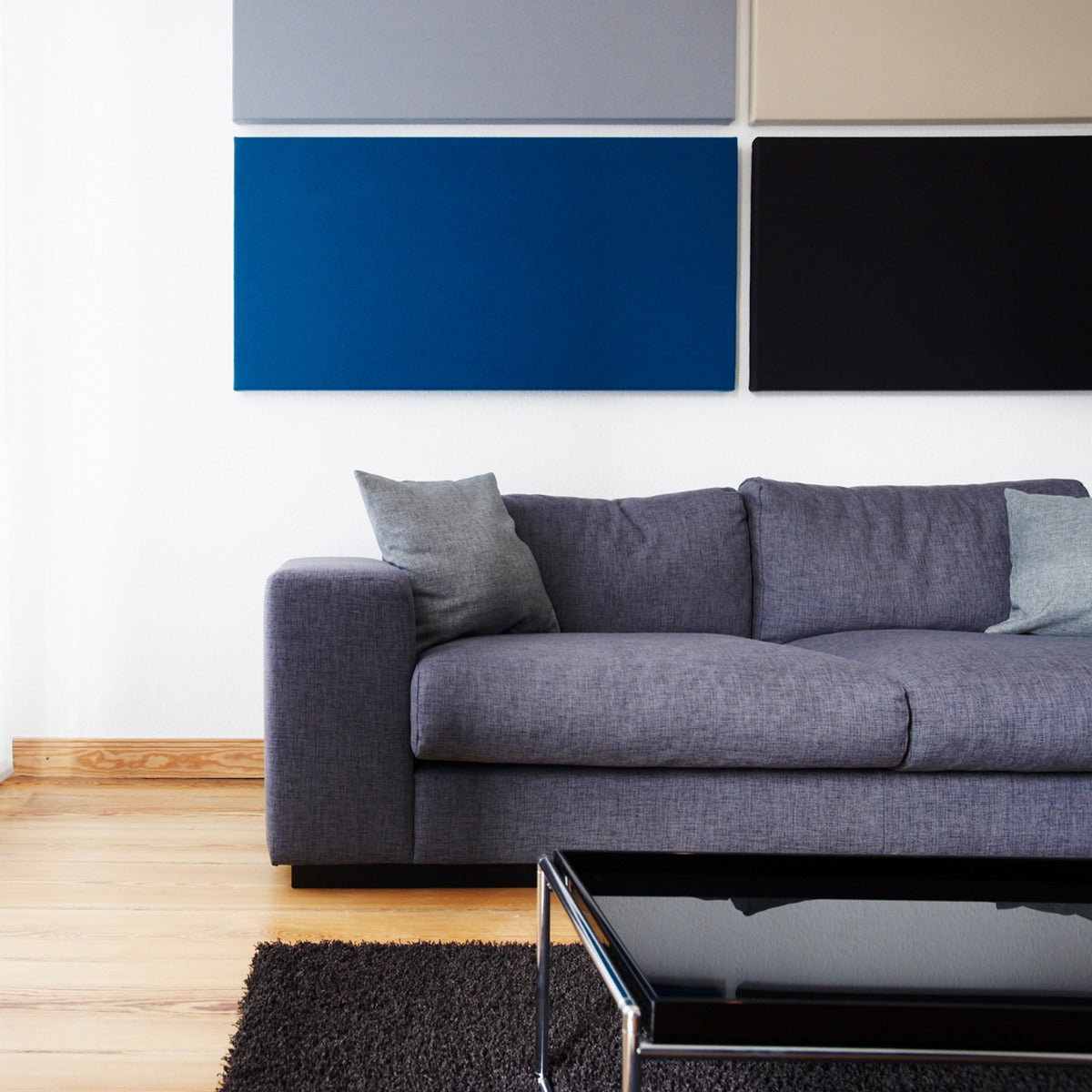
A 40mm acoustic core wrapped in Camira fabric and made to the dimensions you order. It's the panel we recommend most for offices, meeting rooms, classrooms and homes, because it reaches Class A at 40mm, carries B-s1,d0, and arrives with wall spikes and adhesive. Made to measure matters more than it sounds: panels sized to the wall leave fewer untreated gaps than a standard grid, and gaps do nothing for reverberation.
| Absorption | Class A at 40mm |
|---|---|
| Fire | B-s1,d0, confirmed for your chosen fabric |
| Size | Made to measure |
| Price | From £99.95 |
| Choose it if |
|
| Look elsewhere if |
|

Best value modular panel: SilentSpace Square
The same 40mm Class A construction in fixed square sizes, which keeps the price down and makes layouts simple to plan. A grid of squares reads as a deliberate design rather than a retrofit, and if one panel gets damaged you replace that panel, not the wall. Fixings and adhesive are included.
| Absorption | Class A at 40mm |
|---|---|
| Fire | B-s1,d0 |
| Size | Multiple square sizes |
| Price | From £45.68 |
| Choose it if |
|
| Look elsewhere if |
|

Best ceiling raft: SilentSpace Circle, Square and Rectangle rafts
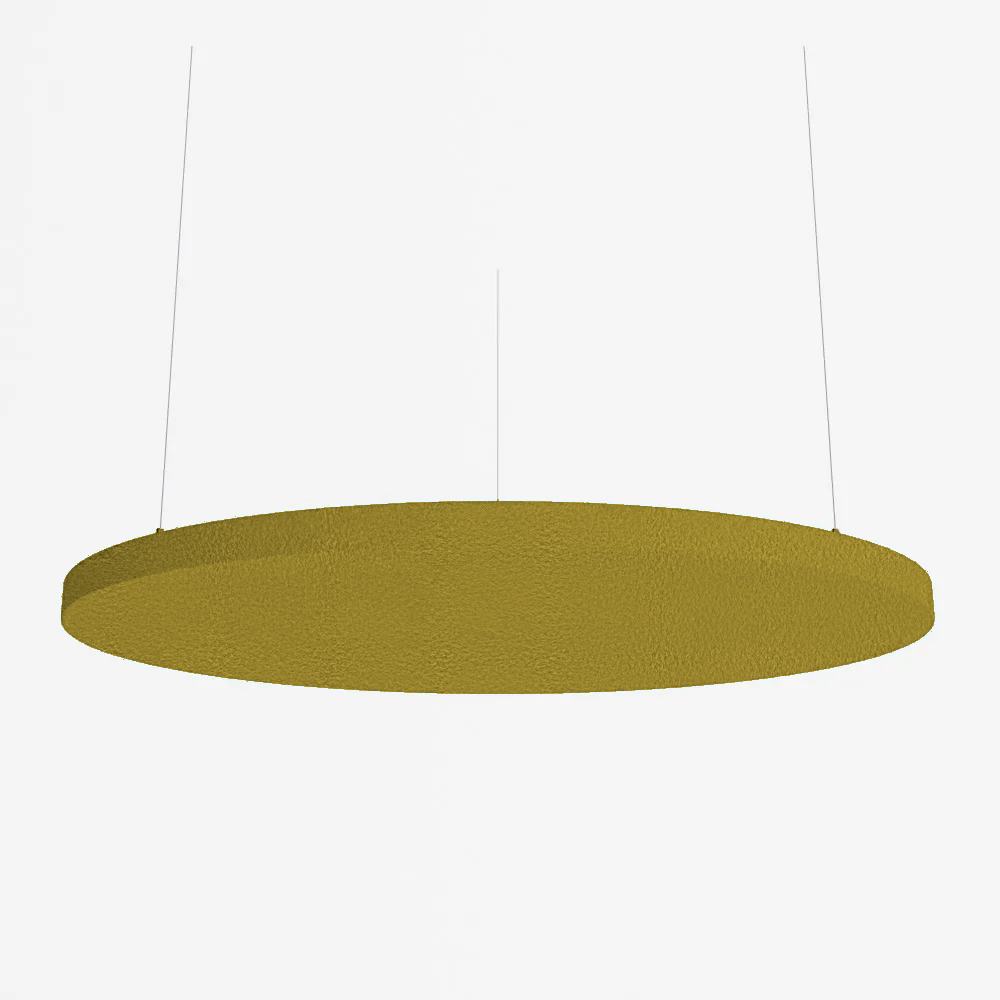
A suspended raft absorbs on both faces and around its edges, so it removes more sound per square metre of panel than anything fixed flat to a wall. That makes rafts the most efficient fix in rooms where the walls are glazed or already full, which describes most modern offices and restaurants. SilentSpace rafts come in 48 Camira colourways with Gripple hangers and spirals included.
Check the thickness when you order: these rafts are Class A at 40mm but Class C at 25mm.
| Absorption | Class A at 40mm (Class C at 25mm) |
|---|---|
| Fire | B-s1,d0 |
| Size | Standard shapes, or custom up to 2400 × 1200mm |
| Price | From £99.95 |
| Choose it if |
|
| Look elsewhere if |
|

Best where the fire strategy requires A2: Ecophon Solo
Solo rafts use a glass wool core, which is why they reach A2-s1,d0: the highest class available to a product that isn't entirely non-combustible. That's the rating to specify where a fire strategy sets a limited-combustibility requirement, which is common in escape routes, atria and taller buildings. They're stock items, available as circles, squares and rectangles.
| Absorption | Class A |
|---|---|
| Fire | A2-s1,d0 |
| Size | Circles 800 or 1200mm, square 1200 × 1200mm, rectangle 1800 × 1200mm |
| Price | From £175 |
| Choose it if |
|
| Look elsewhere if |
|

Best for schools, sports halls and busy corridors: SilentSpace High-Impact Square
A standard fabric panel won't survive stray balls or furniture being wheeled past it. The High-Impact Square keeps Class A absorption and adds independently tested impact resistance, so it can go on the lower walls where softer panels would be damaged. Spikes and adhesive are included, and the modular format means a damaged panel is swapped individually.
| Absorption | Class A |
|---|---|
| Fire | B-s1,d0 |
| Impact | Independently tested |
| Price | £65 per panel |
| Choose it if |
|
| Look elsewhere if |
|

Best for whole-wall coverage: Autex Cube
A 2440 × 1220mm sheet of polyester fibre with a minimum of 60% recycled content, usable as a full wall covering or cut to shape on site. Be clear about what you're buying: Cube is Class C–D for absorption depending on thickness, so it takes more wall area to match a Class A panel. It earns its place where coverage, colour and the ability to cut on site matter more than absorption per square metre.
| Absorption | Class C–D, by thickness |
|---|---|
| Fire | 12mm B-s1,d0; 24mm B-s2,d0 |
| Size | 2440 × 1220mm, 12 or 24mm |
| Price | From £285 per sheet |
| Choose it if |
|
| Look elsewhere if |
|

Best timber finish: Lignosi Eco Sound slat panels
Real wood veneer slats on a recycled PET backing, 2400 × 600mm and 22mm deep. As supplied they're Class C; with 45mm of insulation fitted behind them, they reach Class A. That makes them one of the few timber looks that can do serious acoustic work, as long as you can allow for the extra depth. They fix with contact adhesive or with black screws that sit almost invisibly between the slats, and lead time is typically 4–5 days.
| Absorption | Class C; Class A with 45mm insulation behind |
|---|---|
| Fire | Not FR Rated - treatment required |
| Size | 2400 × 600mm, 22mm |
| Price | From £85.99 |
| Choose it if |
|
| Look elsewhere if |
|
Best natural texture: BAUX wood wool panels
Wood wool is made from wood fibres bound with cement, giving a textured surface that suits design-led and sustainability-focused interiors. BAUX's Arch, Curve and Diagonal panels are 1160 × 580mm, and Curve and Diagonal come in left- and right-hand versions so a pattern can be mirrored across a wall.
| Absorption | Class C |
|---|---|
| Fire | B-s1,d0 |
| Size | 1160 × 580mm |
| Price | £105.72 per panel |
| Choose it if |
|
| Look elsewhere if |
|
Best sculptural feature wall: De Vorm Mute
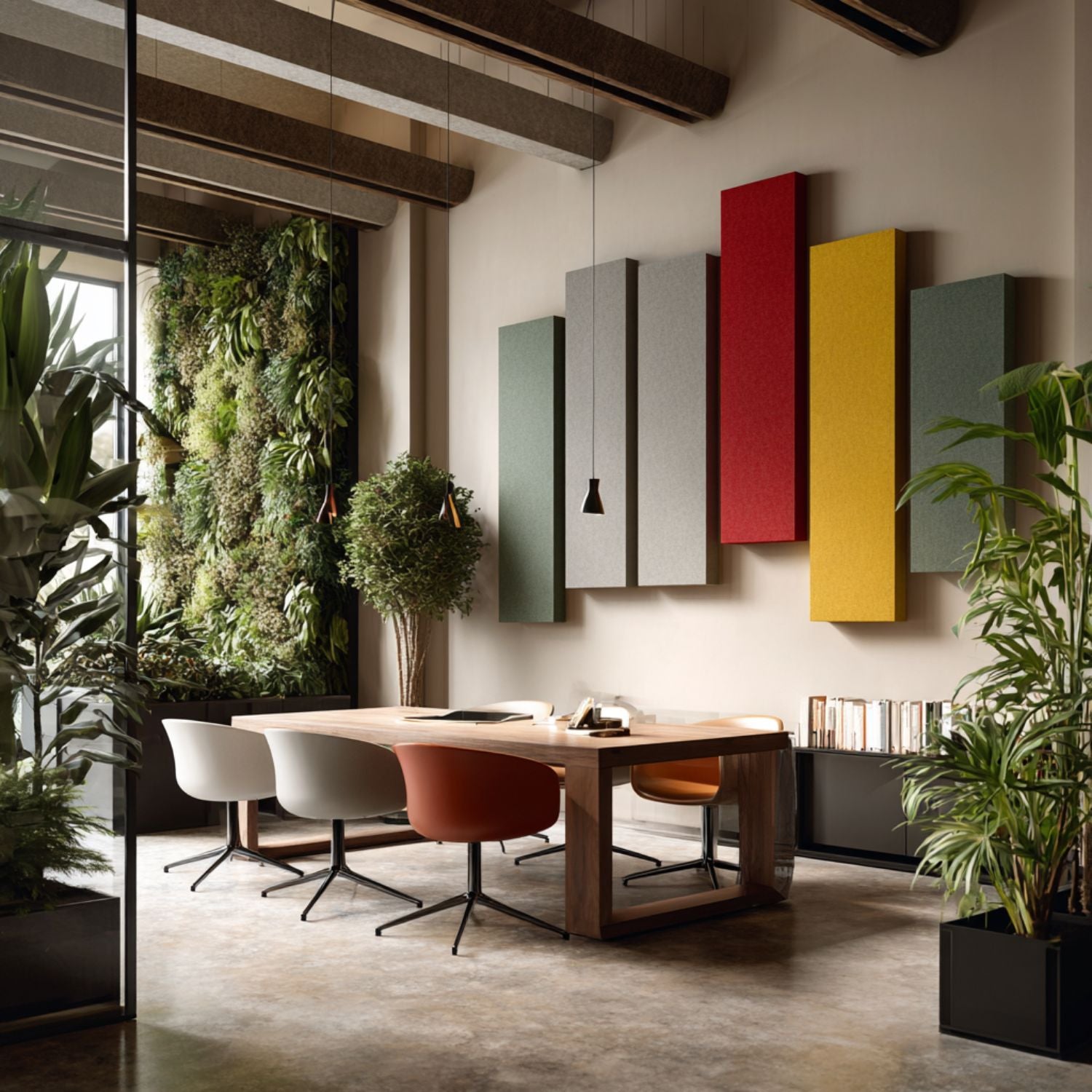
Large 2390 × 790mm PET felt panels in three patterns (Flat, Fit and Flow) and 11 colours. De Vorm has its roots in furniture design, and these are panels chosen for how a wall looks first, with absorption alongside it.
| Absorption | Class C, Class A with additional backing |
|---|---|
| Fire | FR treatment required |
| Size | 2390 × 790mm |
| Price | From £375 |
| Choose it if |
|
| Look elsewhere if |
|
Best for your own artwork: SilentSpace Printed Art panels
A Class A panel printed with artwork you supply, so the acoustic treatment can carry photography, branding or wayfinding. Useful in restaurants, receptions and classrooms where a plain panel would look out of place. Fire classification applies to the complete panel including the printed fabric, so we'll confirm the figure for your order.
| Absorption | Class A |
|---|---|
| Fire | The core is tested to B-s1,d0 |
| Size | Multiple sizes |
| Price | From £175 |
| Choose it if |
|
| Look elsewhere if |
|

How to choose the right acoustic panel
Check the absorption class at the thickness you're ordering
In the UK, absorption is rated under BS EN ISO 11654. Measured performance is converted into a single weighted coefficient, αw, and then into a class from A to E. Thickness changes the result: the same fabric-wrapped construction can be Class A at 40mm and Class C at 25mm, so check the class applies to the panel you're actually buying.
| Class | Weighted coefficient (αw) | What it means in practice |
|---|---|---|
| A | 0.90–1.00 | The highest class. The right target for offices, meeting rooms and classrooms. |
| B | 0.80–0.85 | Effective, with slightly more coverage needed. |
| C | 0.60–0.75 | Useful, but noticeably more coverage for the same result. |
| D–E | 0.15–0.55 | Mainly decorative. Fine for light treatment, not for a problem room. |
You'll also see NRC quoted, particularly on products from the US. It's calculated differently and isn't directly interchangeable with absorption class, so compare products using the same standard. If a panel only lists NRC, ask for the αw figure.
Check the fire classification for where the panel is going
Panels fixed to walls or ceilings are internal linings under the Building Regulations, and the minimum Euroclass depends on the location rather than the building. Corridors and escape routes are stricter than the rooms they serve. Most commercial projects specify B-s1,d0 or better, and A2-s1,d0 where a fire strategy calls for limited combustibility. Our guide to fire rated acoustic panels covers the requirements room by room.
Decide between walls, ceiling or both
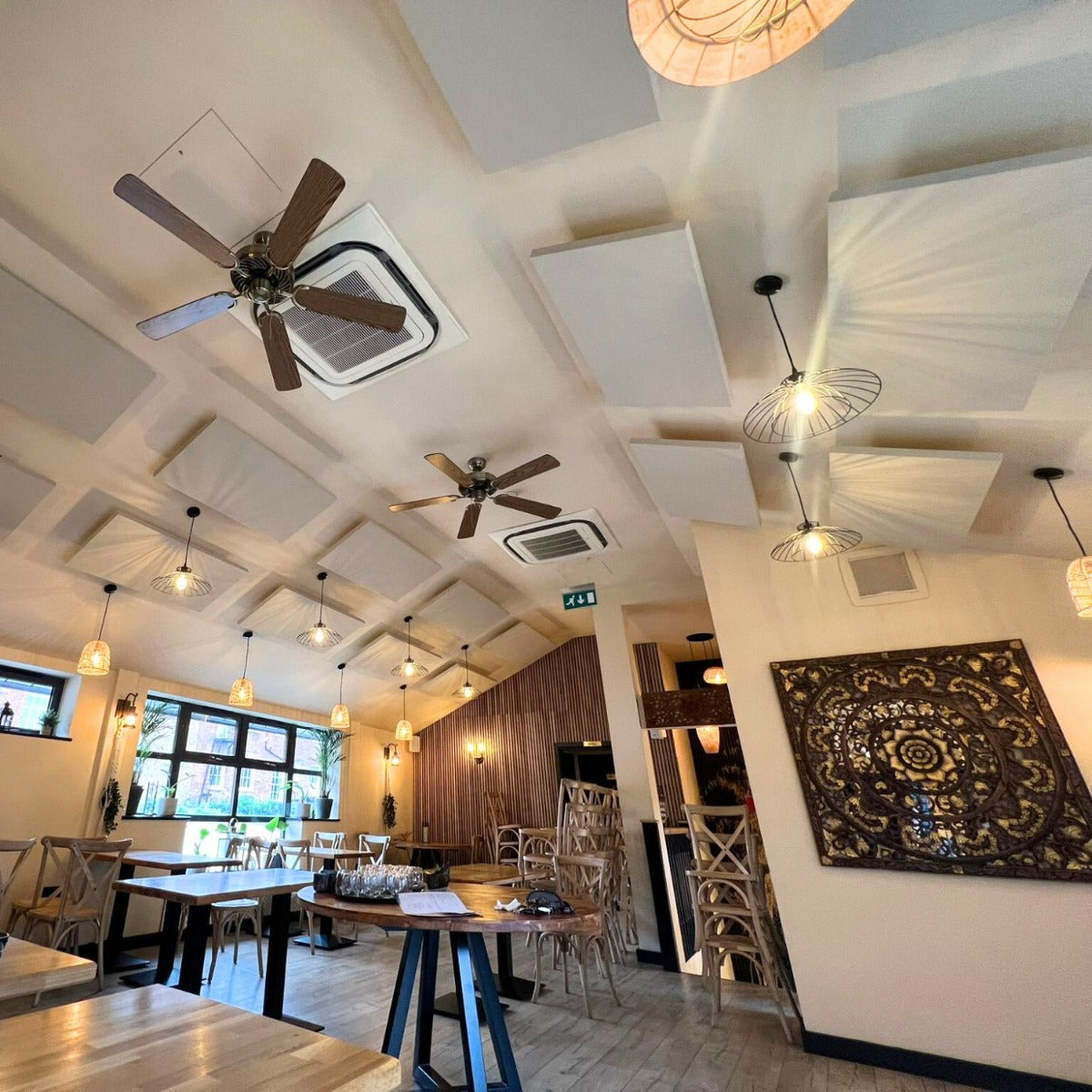
Ceiling rafts deliver the most absorption per panel and suit open-plan spaces and high ceilings. Wall panels are easier to fit, work well in meeting rooms and smaller rooms, and let you place absorption at seated head height. In rooms with hard walls and a hard ceiling, treating both usually gets the best result. Our comparison of wall panels and ceiling rafts goes into more detail.
Check what's included in the price
Some panels include fixings and adhesive; others need suspension kits or brackets added at checkout. Fitting a panel with an air gap behind it extends absorption into lower frequencies, so check which fixings allow that if it matters for your room.
Best acoustic panels by space
| Space | Start with | Shop |
|---|---|---|
| Open-plan office | Ceiling rafts first, then wall panels on any free walls | Office acoustic panels |
| Meeting room | Class A wall panels at seated head height, plus a raft over the table if the ceiling is hard | Meeting room acoustic panels |
| Home office | 40mm fabric-wrapped panels behind and beside the desk | Home office acoustic panels |
| Restaurant or bar | Ceiling rafts, which leave walls free for windows, art and seating | Restaurant and bar acoustic panels |
| Classroom | Ceiling treatment, with impact-resistant panels on lower walls | Classroom acoustic panels |
| Gym or sports hall | Rafts or baffles on the ceiling, impact-rated panels below about 2.5m | Sports hall acoustic panels |
| Village hall or church | Suspended rafts, which handle high ceilings well | Village hall or church acoustic panels |
| Living room | Timber slat or fabric panels as a feature wall | Living room acoustic panels |
| Music studio | Panels at first reflection points, with deeper treatment for bass | Music studio acoustic panels |
What to avoid
Acoustic foam in commercial or public spaces
Polyurethane foam typically classifies somewhere between Euroclass C and F, which rules it out of most commercial rooms and all escape routes. Thin foam also does little outside the high frequencies.
A "Class A" claim with no standard named
Class A can mean top-class sound absorption under BS EN ISO 11654, or it can be a US fire rating that doesn't apply in the UK. They say nothing about each other. If a listing just says "Class A", ask which standard it refers to.
Expecting panels to stop noise from next door
Acoustic panels absorb sound inside a room. They don't stop sound travelling through walls, floors or ceilings, which needs added mass and airtight construction. We explain the difference in will acoustic panels keep sound out?
Expecting thin panels to control bass
No 25–40mm panel of any material does much below about 250Hz. Low-frequency absorption depends on depth and air gap, so a cinema room or music production space needs a different approach. Talk to us before ordering.
How many acoustic panels do you need?
It depends on the room's volume, what its floor, walls and ceiling are made of, and the reverberation time you're aiming for, which is why rules of thumb vary so widely. Our acoustic calculator takes about two minutes. It estimates your room's current reverberation time and tells you how many panels you need to reach the right target.
Before you order. Fabric colour looks different under your lighting than on screen, so order samples before a large order. Prices are supply only; if you'd like panels fitted, arrange installation before you buy. For large or complex commercial projects that need a measured survey, our sister company Resonics handles survey, design and installation across the UK.
Frequently asked questions
What are the best acoustic panels for most rooms?
For most offices, meeting rooms, classrooms and homes, the best choice is a 40mm fabric-wrapped panel rated Class A for absorption under BS EN ISO 11654 and Euroclass B-s1,d0 or better for fire. Where a fire strategy requires limited combustibility, choose an A2-s1,d0 product such as Ecophon Solo.
What absorption class should acoustic panels have?
Class A, meaning a weighted absorption coefficient of 0.90 or above, for rooms where speech matters, such as offices, meeting rooms and classrooms. Class B and C panels still work but need more coverage for the same result. Class D and E panels are mainly decorative.
Is NRC the same as absorption class?
No. NRC is a US rating calculated differently from the αw figure used for absorption class under BS EN ISO 11654, and the two aren't directly interchangeable. Compare panels using the same standard, and ask for the αw figure if a product only lists NRC.
Are ceiling rafts better than wall panels?
Ceiling rafts absorb on both faces and their edges, so they remove more sound per square metre of panel and are usually the better first step in open-plan offices, restaurants and halls. Wall panels are easier to fit and suit meeting rooms and smaller rooms. Many rooms benefit from both.
How many acoustic panels do I need?
It depends on the room's volume, its existing surfaces and the reverberation time you're aiming for, so a fixed rule of thumb is unreliable. Our acoustic calculator takes about two minutes and gives you a panel quantity for your room.
Will acoustic panels stop noise from next door?
No. Acoustic panels absorb sound inside a room to reduce echo and reverberation. Stopping sound travelling between rooms needs added mass and airtight construction, which is a building problem rather than a panel problem.
Can I cut acoustic panels to size?
It depends on the material. PET panels such as Autex Cube can be cut on site. Fabric-wrapped panels can't, because the fabric is tensioned and finished around the edges during manufacture, so order those made to measure.
Is acoustic foam good enough?
For a small home studio on a tight budget, foam can help with high-frequency echo. For commercial and public spaces it's rarely suitable: polyurethane foam typically classifies between Euroclass C and F, and thin foam does little outside the high frequencies.


