













When you compare wall panels and ceiling rafts for office noise, the headline difference comes down to efficiency. Because a ceiling raft is suspended, it absorbs sound across both faces and its exposed edges, so it removes more total sound energy per square metre than a wall panel of the same size and material. That efficiency doesn't make rafts the right answer for every office, though. The best choice depends on your room, your ceiling height, your budget, and the specific acoustic problem you need to solve.
Key Takeaways
| Question | Answer |
|---|---|
| What is the main purpose of both solutions? | Both reduce reverberation and echo by absorbing sound before it builds up and bounces around the room. |
| Which absorbs more sound per square metre? | Ceiling rafts. Suspended in the room, they absorb across both faces and their edges, removing more total sound energy per square metre than a single-faced wall panel of the same size. |
| Which is easier to install in a retrofit? | Wall panels. They mount directly to a wall and need no ceiling suspension work, which is why they dominate retrofit projects. |
| What is RT60 and why does it matter? | RT60 is the time it takes for sound to decay by 60 decibels after the source stops. A shorter RT60 means speech clears faster and conversations are easier to follow. |
| Can you use both together? | Yes. In many open-plan offices, combining the two is the most effective way to control reverberation across the full frequency range. |
| What NRC rating should I look for? | For offices, look for panels rated NRC 0.80 or above. A panel rated NRC 0.85 absorbs roughly 85% of the sound that strikes its surface, which makes a measurable difference to speech clarity. |
| Where can I buy acoustic ceiling rafts in the UK? | Browse our full range of acoustic ceiling panels and rafts, with Class A absorption options and fast UK delivery. |
Why Office Noise Is a Bigger Problem Than Most People Realise
Noise is everywhere in offices, whether it's an open-plan floor of fifty people, a glass-walled meeting room, or a hybrid workspace with a hard exposed ceiling. The acoustic environment in most modern offices simply isn't designed for focused work or clear conversation.
Our brains find it difficult to tune out colleague discussions, phone calls, and the general hum that poor office acoustics amplify. The problem isn't just volume; it's the build-up of reflected sound that makes the whole space feel louder and more chaotic than it really is. When sound waves hit hard surfaces such as concrete floors, glass partitions, painted plasterboard, and exposed ceilings, they bounce back into the room instead of being absorbed. That build-up is reverberation, and it's what makes an untreated space tiring to work in.

The metric that captures this is RT60: the time, in seconds, it takes for sound in a room to decay by 60 decibels after the source stops. A long RT60 means speech constantly overlaps with its own echoes, so following a discussion takes effort and fatigue sets in quickly.
To calculate RT60 in your space, try our acoustic calculator.
How Acoustic Wall Panels and Ceiling Rafts Actually Work
Both solutions share the same mechanism. Acoustic panels are made from porous, fibrous, or foam-based materials that convert sound energy into a tiny amount of heat as sound passes through them. The waves enter the material, travel through a tortuous path of fibres, and lose energy with every pass. The more surface area exposed to the room, and the denser the material, the more effective the absorption across the frequency range.
The performance rating to look for is the Class, with an averaged figure on a scale from 0 to 1 where a higher number means more absorption. A panel rated 0.90 absorbs roughly 90% of the sound that strikes its surface. Products in the highest sound-absorption class — Class A products under ISO 11654 have a weighted absorption coefficient (αw) of 0.90 or above
Wall panels and ceiling rafts both rely on this mechanism. The difference lies in their geometry, their placement, and the way each one intercepts sound in the room.
Comparing Wall Panels and Ceiling Rafts: The Core Differences
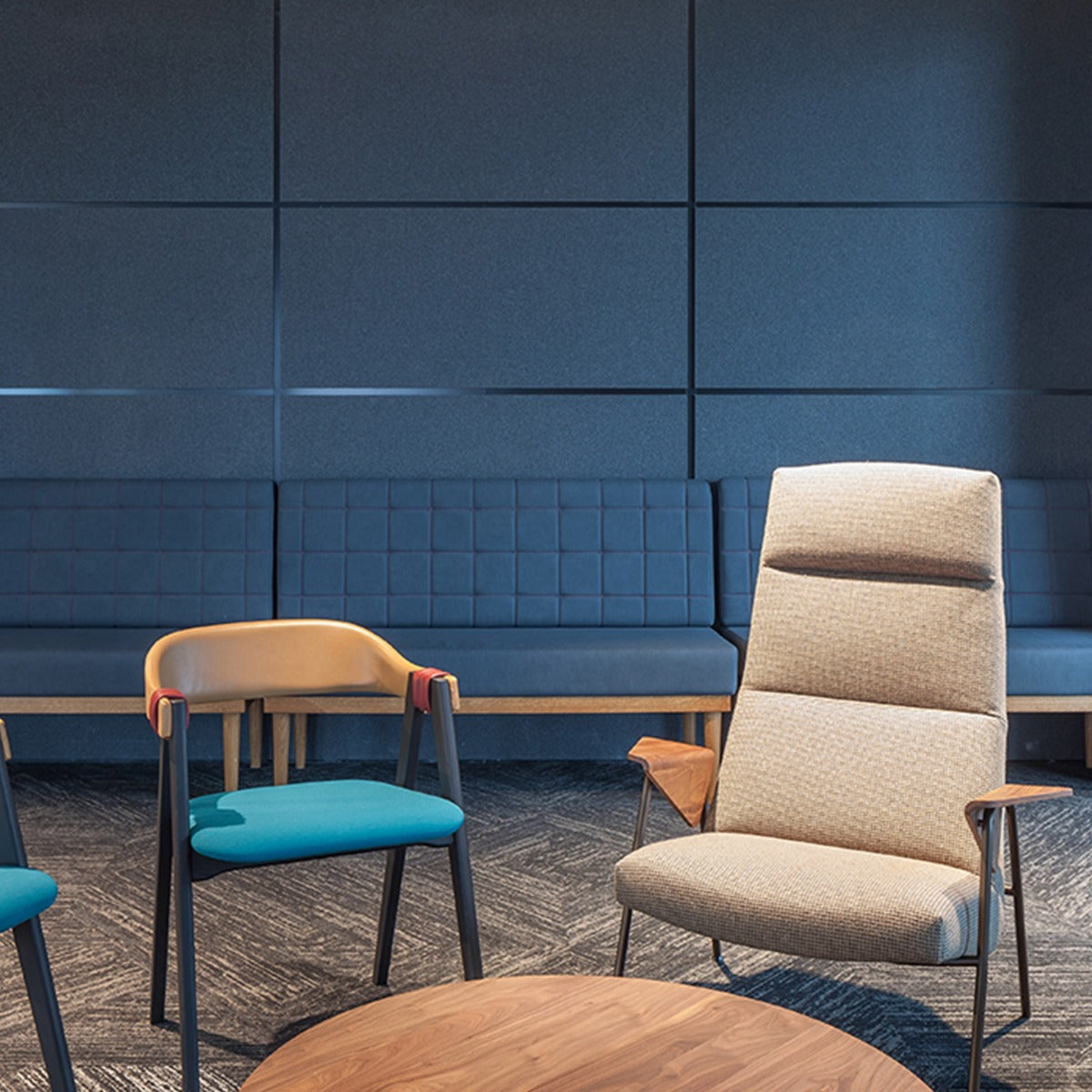
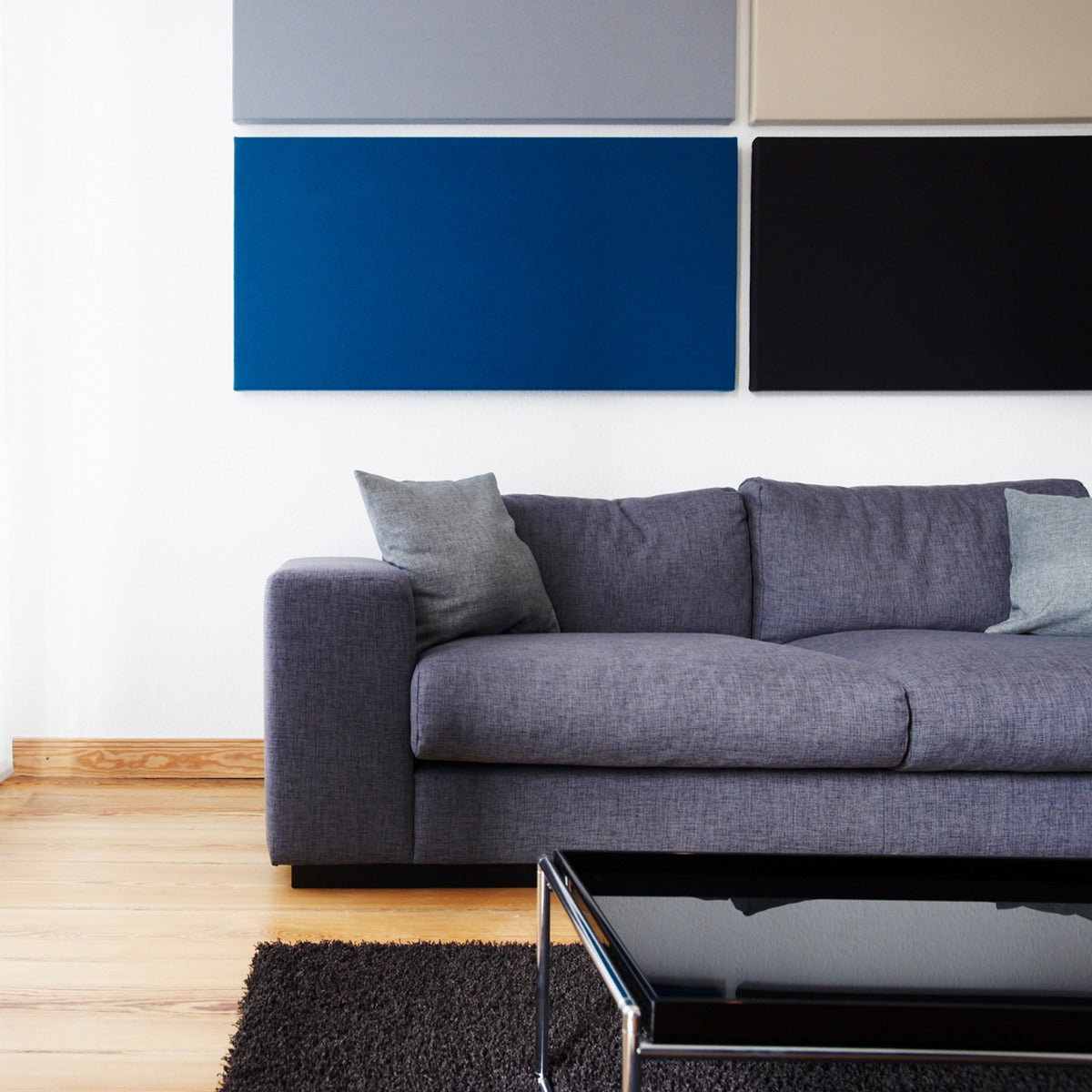
Wall panels are flat, fabric-wrapped or foam-based panels that mount directly onto vertical wall surfaces. They're straightforward to position, need no rigging or suspension hardware in most cases, and come in a wide range of sizes and colours to suit the interior.
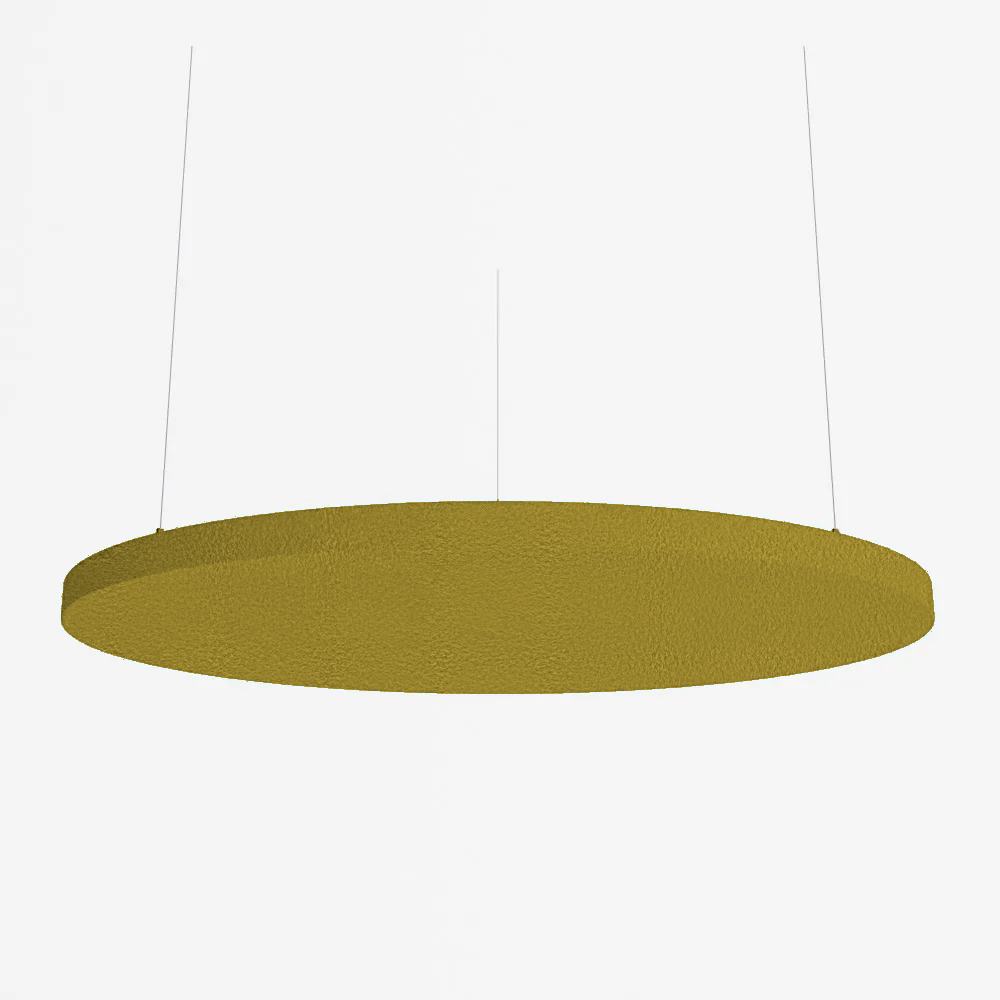
Ceiling rafts are horizontal panels suspended below the ceiling, hanging parallel to the floor. They intercept sound as it rises and falls through the room, absorbing across both their top and bottom faces as well as their exposed edges. That extra absorbing area is what gives a raft its efficiency advantage over a wall panel of the same size.
A quick visual guide to three key differences between wall panels and ceiling rafts for office noise. Learn which option better reduces sound in open offices.
Here is a direct comparison across the criteria that matter most for offices:
| Criteria | Wall Panels | Ceiling Rafts |
|---|---|---|
| Absorption | Typically 0.75–1.00 | Typically 0.90+ (Class A) |
| Effective absorption | Single absorbing surface | Both faces plus edges — more total absorption per m² |
| Installation complexity | Low (wall mounting) | Moderate (suspension from ceiling) |
| Best for | Meeting rooms, enclosed offices, retrofit projects | Open-plan floors, high-ceiling spaces, new builds |
| Visual impact | Discreet, wall-art style | Architectural feature that floats above the workspace |
| Frequency performance | Strong mid-to-high absorption | Broad absorption, especially mid-range |
| Cost entry point (UK) | Lower per panel | From £99.95 (SilentSpace fabric-wrapped raft) |
Did You Know?
Fabric-wrapped panels are the single largest product format in the acoustic wall coverings market, holding around 45% share — driven in large part by how easily they retrofit into existing offices.
Source: Fact.MR, Acoustic Wall Coverings Market (2026)
Wall Panels for Office Noise: What They Do Best
Wall panels excel in enclosed or semi-enclosed spaces. Meeting rooms, private offices, video-conferencing booths, and breakout areas with defined walls are all places where wall panels deliver reliable, consistent results at an accessible cost.
Their core strength is treating the reflective surfaces that surround a conversation directly. When sound hits a treated wall instead of bare plasterboard or glass, it's absorbed rather than reflected, so the room's RT60 shortens and speech becomes noticeably cleaner. Placement matters, though. The most impactful positions are:
- On the wall directly opposite the primary speaker or screen
- On side walls at ear height, roughly 1 to 2 metres from the floor
- In corners, where lower frequencies tend to accumulate
- Behind and to the sides of any microphone or conferencing equipment

Acoustic comfort is often an afterthought in a fit-out, and wall panels are frequently chosen precisely because they can be added afterwards without any structural alteration. For retrofit projects in particular, they're the fastest, most cost-effective route to a noticeably better acoustic environment.
Ceiling Rafts for Office Noise: When Suspended Panels Win
In most modern offices, the ceiling is one of the largest hard surfaces in the room — and it's rarely treated. Left bare, it keeps sound circulating through the air far longer than it should.
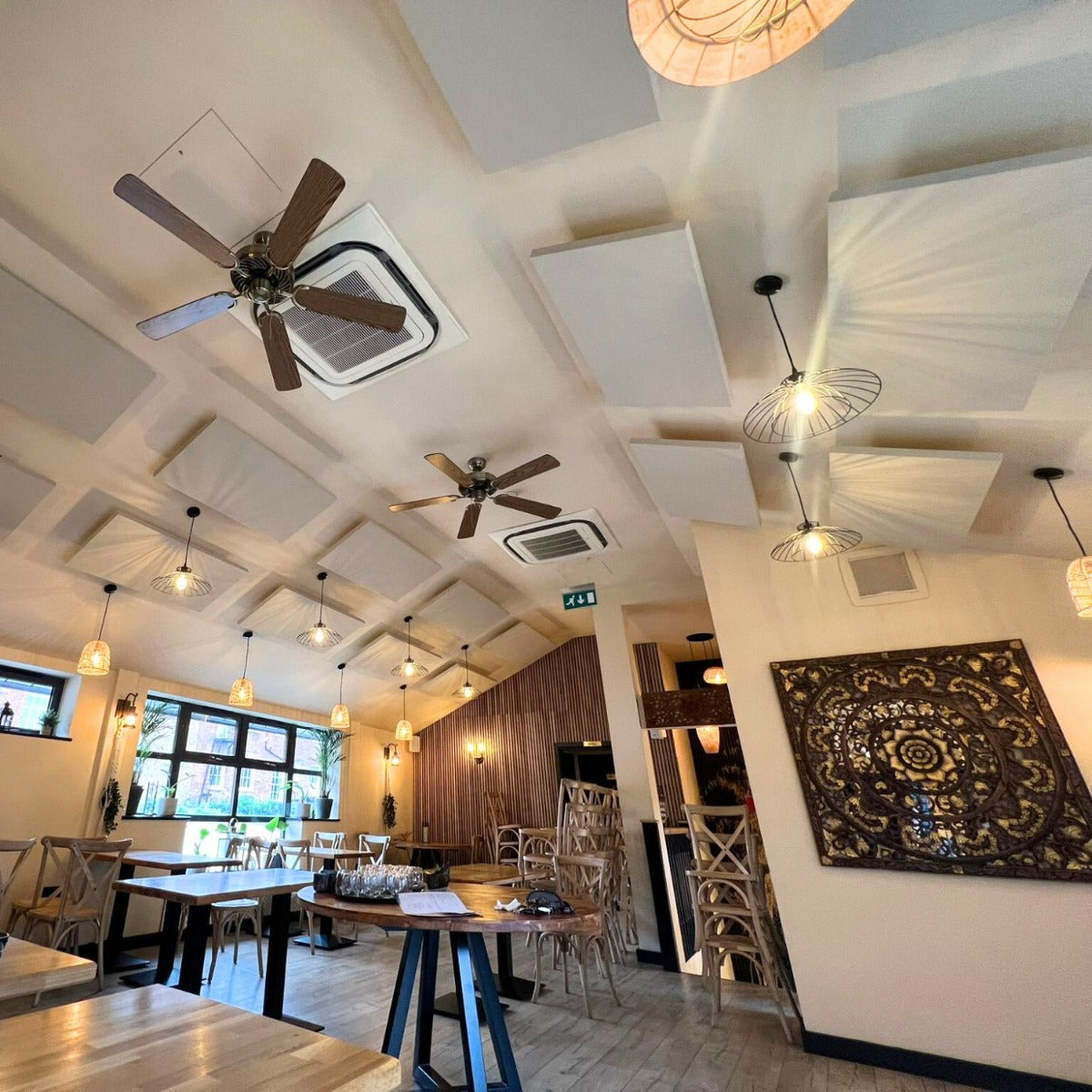
A ceiling raft interrupts that cycle. Suspended below the structural ceiling on wire or rod hangers, it sits directly in the path of rising and falling sound waves. Because it hangs free, sound reaches both its faces and its edges, so its effective absorbing area is far greater than a wall-mounted panel of the same dimensions. In an open-plan office with a ceiling height of three metres or more, rafts placed above workstations or meeting clusters can dramatically reduce RT60 without using any wall space at all.

Rafts are also a strong aesthetic choice. They read as an architectural feature rather than a retrofit, and products like the SilentSpace Fabric Wrapped Acoustic Ceiling Raft have made that performance available without compromising the look of the space. The SilentSpace raft starts from £159, is lightweight and straightforward to install, and is available in custom sizes — useful in open-plan offices where coverage needs to be planned precisely around the floor layout below.
Which Office Type Suits Which Solution?
The right choice often comes down to the room rather than a universal rule. Here's a practical breakdown.
Meeting rooms and boardrooms
These are typically enclosed, with defined walls and lower ceilings. Wall panels are usually the better primary treatment, placed on the walls around the table to shorten RT60 where conversations actually happen. A raft above the table can complement them in rooms with hard exposed ceilings, but the walls usually offer the most practical absorption area. If a room hosts video calls regularly, well-placed meeting room acoustic panels improve both the in-room and the remote listening experience.
Open-plan offices
This is where rafts tend to perform best. The sheer volume of the space, combined with a limited wall-to-floor ratio and high ceilings, means wall panels alone rarely provide enough coverage. Rafts suspended in clusters above desks and collaboration zones intercept sound before it travels across the floor, bringing down the ambient noise level that makes open offices so uncomfortable.
Collaborative zones and breakout areas
These often combine both space types: some defined walls, plus openings into the wider floor. A combination works well — wall panels on any solid surfaces, and a raft or two above the main seating area — keeping conversations contained rather than radiating outward.
Pods and focus booths
In an enclosed pod or phone booth, wall panels on three or four sides are usually enough on their own. The compact volume means even moderate absorption brings RT60 down quickly. If the booth has a hard ceiling, a single small raft makes the comfort feel more complete.
Which Delivers Better Acoustic Performance?
This is a more interesting question than it first appears. A high-quality wall panel rated NRC 0.95 absorbs about 95% of the sound striking its face — excellent performance by any measure. But a raft of the same material, suspended free in the room, absorbs across both faces and its edges. Its total absorption per square metre is therefore substantially higher, even though the single-face coefficient is the same.
In practical terms, that means fewer square metres of raft are needed to achieve the same RT60 reduction as wall panels alone. For large open-plan spaces where wall area is limited or already occupied, that efficiency is exactly why rafts are specified so often.
Did You Know?
Because a suspended raft absorbs across both faces and its open edges, its total absorption per square metre is significantly higher than a wall-mounted panel of identical material — which is why fewer rafts are often enough to hit a target RT60 in open-plan spaces.
Installation: What to Expect
Ease of installation is a real factor, and it's the one area where wall panels hold a clear practical advantage for most offices. They typically attach directly to plasterboard or masonry using impaling clips, adhesive mounts, or standard fixings. Most installations need no specialist trades, and a set of panels can usually go up in a few hours — which is what makes them the default for low-disruption retrofits.
Ceiling rafts need suspension hardware fixed to the structural ceiling, usually via threaded rods or wire kits. In offices with accessible ceiling voids or concrete soffits, that's straightforward. In spaces with complex services, an existing suspended ceiling grid, or restricted access, it takes more planning and possibly specialist help. The SilentSpace raft is designed with this in mind: lightweight construction and a simple suspension system keep the process as easy as possible, and for an open-plan office with a clear concrete soffit it's genuinely manageable without acoustic contractors.
If you're unsure about the structural requirements for your ceiling, our team at Sonio is happy to advise — just get in touch.
Should You Use Both Together?
When panels are already on the walls and the room still won't settle, the ceiling is usually the culprit that's been left untreated. In larger offices, the most effective treatments combine both solutions. Wall panels control lateral reflections, shortening RT60 at head height and improving speech clarity between colleagues seated nearby. Rafts intercept the vertical reflections, stopping sound from accumulating in the upper volume of the room and spilling back down across the floor.
The combined result is a shorter RT60 across a broader range of frequencies, so the whole space feels calmer and easier to work in. We generally target an RT60 of 0.4 to 0.6 seconds for open-plan offices and 0.3 to 0.5 seconds for meeting rooms, and a combined approach makes hitting those targets far more achievable than relying on a single surface. You can explore our full range of ceiling solutions, including Class A options, on the acoustic ceiling panels collection page.
Conclusion
Neither solution is universally better. Each has a specific role, and the right choice depends on your space, your ceiling height, the scale of the problem, and how much disruption you can manage during installation.
Wall panels are the practical, flexible, lower-cost starting point for most enclosed offices and meeting rooms. They're easy to install, highly effective at reducing reverberation at ear height, and available in designs that work with the interior.
Ceiling rafts deliver more absorption per square metre in open-plan environments and large rooms with high, hard ceilings. Their dual-face geometry makes them exceptionally efficient, and their visual presence can enhance rather than compromise the look of a modern office.
For many offices, the real answer is both. Start with whatever addresses your most pressing problem, add the complement where the budget allows, and you'll find that acoustic comfort — so often an afterthought — becomes one of the most noticeable improvements you've ever made to the working environment.
Frequently Asked Questions
What is the difference between acoustic wall panels and ceiling rafts for office noise?
Wall panels mount on vertical surfaces and absorb sound on one face, which suits meeting rooms and enclosed offices. Ceiling rafts hang horizontally below the ceiling and absorb across both faces and their edges, making them more efficient per square metre in open-plan offices and larger spaces.
Which is better for reducing echo in an open-plan office?
Ceiling rafts are usually the better primary solution, because the large untreated ceiling is typically the dominant source of reverberation in those spaces. Rafts intercept sound as it rises and falls, and their extra absorbing area means fewer panels are needed to achieve a meaningful RT60 reduction than wall panels alone.
Can I use both wall panels and ceiling rafts in the same office?
Yes, and it's often the most effective approach where acoustic problems are significant. Wall panels address lateral reflections at head height while rafts deal with vertical reflections above the room, together delivering a shorter RT60 across a broader frequency range than either manages on its own.
How many ceiling rafts do I need for an open-plan office?
As a starting guide, aim to cover roughly 20 to 40% of the ceiling area, concentrating rafts over the most acoustically active zones such as desk clusters and collaboration areas. The exact number depends on the room volume, ceiling height, and the NRC rating of the raft you choose.
Are ceiling rafts difficult to install in an existing office?
Installation means fixing suspension hardware to the structural ceiling, which is more involved than mounting a wall panel but still manageable in most offices with standard concrete or steel soffits. The SilentSpace Fabric Wrapped Acoustic Ceiling Raft is designed to keep this simple, with lightweight construction and straightforward suspension kits.
What aborption rating should office acoustic panels have?
Look for panels rated 0.80 or above, with Class A products (NRC 0.90 and higher under ISO 11654) being the most effective for demanding environments such as open-plan floors and meeting rooms. A panel rated 0.85 absorbs roughly 85% of the sound that strikes it, which translates to a clearly audible improvement in speech clarity.
Is it worth comparing wall panels and ceiling rafts for a small meeting room?
For a small meeting room, wall panels are almost always the more practical and cost-effective choice, since the enclosed geometry means the walls account for a large share of the total reflective area. A single raft above the table can complement them in rooms with hard ceilings, but in most cases well-placed wall panels will reach the target RT60 on their own.


