




Updated: June 2026
When you're choosing acoustic panels for a room, the numbers on a product specification sheet carry a lot of weight. But without knowing what those numbers represent or how they were obtained, it's easy to misread them, compare unlike products, or simply buy something that doesn't do what you need it to. This guide walks through the full picture: how acoustic panels are tested, what the resulting ratings mean, and how to use that information to make better decisions for your space.
Why Acoustic Panel Testing Exists
Sound behaves differently in every room. Hard surfaces like plaster walls, glass, and concrete reflect sound energy back into the space, which causes echo and reverberation. Acoustic panels are designed to absorb that energy rather than reflect it, but not all panels perform equally well.
Without standardised testing, manufacturers could describe a panel's performance in any way they chose, making it impossible to compare products fairly. Testing protocols create a common language: a set of conditions and measurements that allow you to evaluate one panel against another on equal footing. When you see a rated product on our acoustic wall panels collection, that rating comes from exactly this kind of controlled process.
How Sound Absorption Testing Is Conducted
The most widely used testing method follows ISO 354, which measures sound absorption in a reverberation room. A reverberation room is a specially constructed space with highly reflective surfaces, designed to keep sound bouncing around for as long as possible before dying out.
Testers first measure how long it takes for sound to decay in the empty room. This is called the reverberation time. They then introduce a sample of the panel material, typically around 10 to 12 square metres, and measure the reverberation time again. The difference between the two readings reveals how much sound energy the material absorbed.
This process is repeated across a range of frequencies, usually from 125 Hz up to 4000 Hz, because acoustic materials behave very differently depending on the pitch of the sound. A panel that performs well at high frequencies may absorb much less at low frequencies, and the full-frequency data tells that story clearly.
Understanding the Sound Absorption Coefficient
The core output of ISO 354 testing is the sound absorption coefficient, written as α (alpha). This figure represents the proportion of incident sound energy that the panel absorbs at a given frequency.
The scale runs from 0 to 1. A coefficient of 0 means the surface absorbs nothing and reflects all sound back into the room. A coefficient of 1 means the surface absorbs all incident sound energy. In practice, some materials test slightly above 1.0 due to diffraction effects around panel edges, which is a recognised limitation of the test method rather than an error in the data.
Because α varies across the frequency spectrum, a single frequency-specific figure doesn't give a complete picture on its own. That's why the weighted sound absorption coefficient (αw) was introduced. It condenses performance across the tested frequency range into a single representative number, making it far easier to compare products at a glance.
Acoustic Absorption Classes: A Through E
Once a panel has been tested and assigned an αw value under ISO 11654, it is placed into one of five absorption classes. These classes provide a quick, practical way to judge overall performance without needing to read through full octave-band data every time.
The classes are defined as follows:
-
Class A: αw of 0.90 to 1.00. The highest level of absorption, suitable for spaces where controlling reverberation is critical.
-
Class B: αw of 0.80 to 0.89. High performance, appropriate for offices, meeting rooms, and classrooms.
-
Class C: αw of 0.60 to 0.79. Good absorption, effective for spaces that need moderate acoustic treatment.
-
Class D: αw of 0.30 to 0.59. Limited absorption, often used as supplementary treatment alongside other materials.
-
Class E: αw of 0.15 to 0.29. Low absorption, providing minimal acoustic benefit on its own.
For most commercial and residential spaces where acoustic comfort is the goal, Class A or Class B panels represent the most effective choice. You can browse panels across both ratings in our acoustic ceiling panels range and our wall panel collections.
If you need help deciding how many panels you need, check out our acoustic calculator.
Class A vs Class C: What the Difference Means in Practice
The gap between Class A and Class C performance is significant in real-world use. A Class A panel absorbs around 90% or more of incident sound energy across the weighted frequency range. A Class C panel absorbs between 60% and 79%. In a noisy environment, that difference translates directly into how much echo and reverb you hear.
For example, the SilentSpace Rectangle Acoustic Panels are available in both a 40mm Class A version and a 25mm Class C version. The thicker panel achieves the higher rating because greater depth allows the absorptive core material to trap a wider range of sound wavelengths, including lower frequencies that thinner panels often miss.

If you're treating a loud open-plan office or a restaurant with hard floors and high ceilings, Class A is almost always the better investment. For a smaller room that already has some soft furnishings and just needs a modest acoustic improvement, Class C may be sufficient. Our acoustic calculator can help you estimate how much panel coverage you actually need based on your room dimensions and target reverberation time.
How to Read Frequency-Specific Performance Data
The αw figure is a useful summary, but the full frequency data is where the detail lives. When you look at a panel's specification sheet, you'll often see absorption coefficients listed for each octave band: 125 Hz, 250 Hz, 500 Hz, 1000 Hz, 2000 Hz, and 4000 Hz.
Low frequencies (125 Hz and 250 Hz) are the hardest to absorb because they have long wavelengths. Most standard foam or fabric-wrapped panels perform poorly in this range. Mid frequencies (500 Hz to 2000 Hz) correspond closely to the human voice range, which is where most panels are specifically engineered to perform well. High frequencies (2000 Hz to 4000 Hz) are generally the easiest to absorb and where even basic materials show reasonable results.
If your main problem is excessive bass rumble or booming sound, you'll need panels with particularly strong low-frequency absorption, or dedicated bass traps placed in room corners. If speech clarity is the priority, as it often is in offices, classrooms, and meeting rooms, panels with strong mid-frequency performance are what matter most.
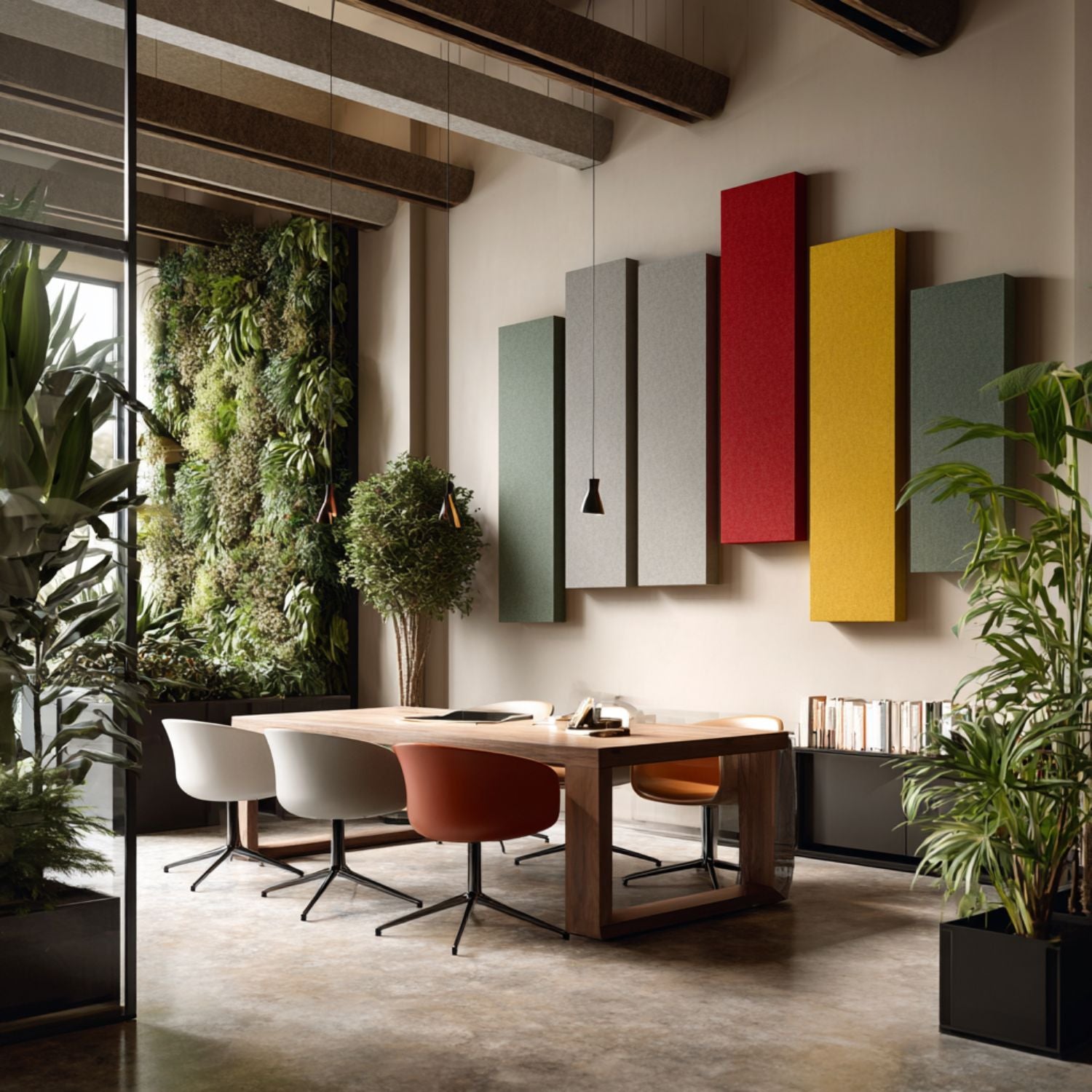
The SilentSpace Fabric Wrapped Acoustic Panel, for instance, is designed with speech intelligibility in mind. Its Class A rating reflects strong absorption across the mid-frequency bands where voice communication is most affected by reverb.
NRC Ratings: The North American Standard
Alongside the European ISO system, you may also encounter the Noise Reduction Coefficient, or NRC. This is a North American standard that works similarly to αw but calculates a single average from the absorption coefficients measured at 250 Hz, 500 Hz, 1000 Hz, and 2000 Hz.
NRC also runs from 0 to 1, with 1 representing complete absorption. An NRC of 0.85 means the panel absorbs an average of 85% of sound energy across those four frequencies. Because NRC focuses specifically on the mid-frequency range, it tends to produce higher headline figures than αw for many products, even when the underlying acoustic performance is similar.
Neither system is inherently better. They are simply different tools for the same purpose. When comparing panels from different manufacturers or markets, check which standard was used so you're reading like-for-like figures. The products in our acoustic ceiling baffles collection are rated under European standards, which is standard practice for products sold in the UK market.
The Role of Panel Thickness in Test Results
Panel thickness has a direct and measurable effect on acoustic performance, particularly in the lower frequency ranges. This relationship exists because the depth of the absorptive core determines how effectively the material can dissipate the energy of longer sound wavelengths.
A 25mm panel may achieve Class C, while the same product in a 40mm version achieves Class A. This is not because the material itself changed, but because the added depth allows low-frequency waves, which penetrate deeper into the panel before reflecting, to be absorbed rather than bounced back. The SilentSpace Rectangle panels referenced earlier illustrate this directly: the 25mm option is Class C, the 40mm option is Class A.
For ceiling-mounted applications, thickness is also a practical consideration. Products like the SilentSpace Rectangle Acoustic Raft are suspended away from the ceiling surface, which adds an air gap that further improves low-frequency absorption beyond what the panel's physical thickness alone would suggest.

How Air Gaps Affect Measured Performance
The way a panel is installed changes its real-world performance, sometimes substantially. When a panel is mounted directly against a wall or ceiling, its absorption properties are constrained by that contact. When the same panel is installed with an air gap behind it, effectively standing it slightly off the surface, its low-frequency absorption improves considerably.
This is because the air gap acts as an additional absorptive layer, allowing sound waves to reflect off the backing surface and pass through the panel twice. Testing labs can perform measurements with and without air gaps, and responsible manufacturers will specify the installation condition under which the test was conducted.
If you're exploring installation options and want to understand the best approach for your space, our fitting guide covers practical mounting methods and the acoustic implications of different approaches. Our FAQ page also addresses common questions about panel placement and coverage.
Free-Hanging Panels and Their Testing Conditions
Free-hanging panels, also known as acoustic rafts or baffles, are tested differently from wall-mounted panels because sound reaches them from both sides. This bilateral exposure means the effective absorption area is greater than the panel's physical face area alone, which typically results in very high αw values, sometimes approaching or exceeding Class A performance even for relatively thin products.
The Ecophon Solo Rectangle, available at £559.00 for the 1800 x 1200mm size, is a good example of a free-hanging panel designed to perform at high levels across mid-to-high frequency ranges. It is commonly specified for open-plan offices, schools, and restaurants where ceiling-level treatment is the most practical option.

When comparing free-hanging panels to wall panels using their αw ratings, keep in mind that the test conditions differ. A free-hanging panel with an αw of 1.0 and a wall panel with an αw of 1.0 deliver comparable absorption per unit area, but the ceiling-mounted panel achieves this through two exposed faces rather than one.
Shape and Panel Geometry in Testing
Most acoustic panel performance data is generated using rectangular flat panels, which is the standard geometry for ISO 354 testing. Non-rectangular shapes, such as circles or irregular forms, are often assigned performance ratings based on the same core material and thickness tested in a rectangular format.
The practical difference is that shaped panels sometimes benefit from additional edge diffraction, particularly when they have more perimeter relative to their surface area. Circular panels, for instance, have a high perimeter-to-area ratio, which can contribute positively to real-world absorption in a way that flat-panel test data doesn't fully capture.
The SilentSpace Circle Acoustic Panels use the same high-density absorptive core and fabric finish as their rectangular counterparts, starting from £115.00. The fabric surface prevents sound from reflecting off a hard face and instead draws it into the absorptive core, which is what makes the soft finish so important to the panel's real performance.

Applying Performance Ratings to Real Rooms
Understanding test ratings is only useful if you can translate them into decisions about a real space. The key variable is reverberation time, written as RT60, which measures how long it takes for sound to decay by 60 decibels after a source stops. Most occupied spaces benefit from an RT60 somewhere between 0.4 and 0.8 seconds, depending on use.
To reduce reverberation time, you add absorptive surface area. The αw rating tells you how efficiently each square metre of panel contributes to that absorption. A Class A panel absorbs around 50% more sound energy per square metre than a Class C panel, which means you need significantly fewer panels to achieve the same result in the same room.
Coverage also matters. Concentrating all panels on one wall is less effective than spreading treatment across multiple surfaces. Placing panels at reflection points (the surfaces where sound bounces directly between the source and the listener) gives a greater return per panel than random placement. Our bespoke acoustic design service can help plan panel placement for specific rooms, and the acoustic calculator gives a starting point for coverage estimates based on room size.
What to Look for in a Panel's Technical Data Sheet
A well-documented panel should come with a data sheet that includes the full octave-band absorption coefficients at each standard frequency, the weighted sound absorption coefficient (αw), the absorption class, the test standard used (typically ISO 354 and ISO 11654), and the installation conditions under which the test was performed.
If a product only lists a single headline number without showing the frequency breakdown or specifying the test standard, treat that data with caution. A single number can be selected from a frequency point where the panel performs well, without reflecting how it behaves across the full range. Reputable manufacturers publish complete data sheets, and at SONIO we stock products from brands that provide transparent, independently verified performance data.
You can explore the full range of tested, specification-grade panels across our acoustic screens and ceiling baffle collections, or contact our team via the contact page if you need help interpreting a data sheet for a specific product or project.
Conclusion
Acoustic panel performance ratings are not arbitrary numbers. They come from a controlled, standardised process designed to let you compare products honestly and choose the right solution for your space. Understanding what αw and absorption classes mean, how frequency data is read, and how installation conditions affect real-world results puts you in a far stronger position when specifying panels.
The short version: Class A panels with an αw of 0.90 or above offer the strongest absorption per square metre. Thickness matters, especially for low frequencies. Free-hanging ceiling panels benefit from dual-face exposure. And installation method affects performance almost as much as the panel specification itself.
If you're ready to choose, start with our acoustic wall panels collection or use the acoustic calculator to get a clearer picture of what your room actually needs.


