


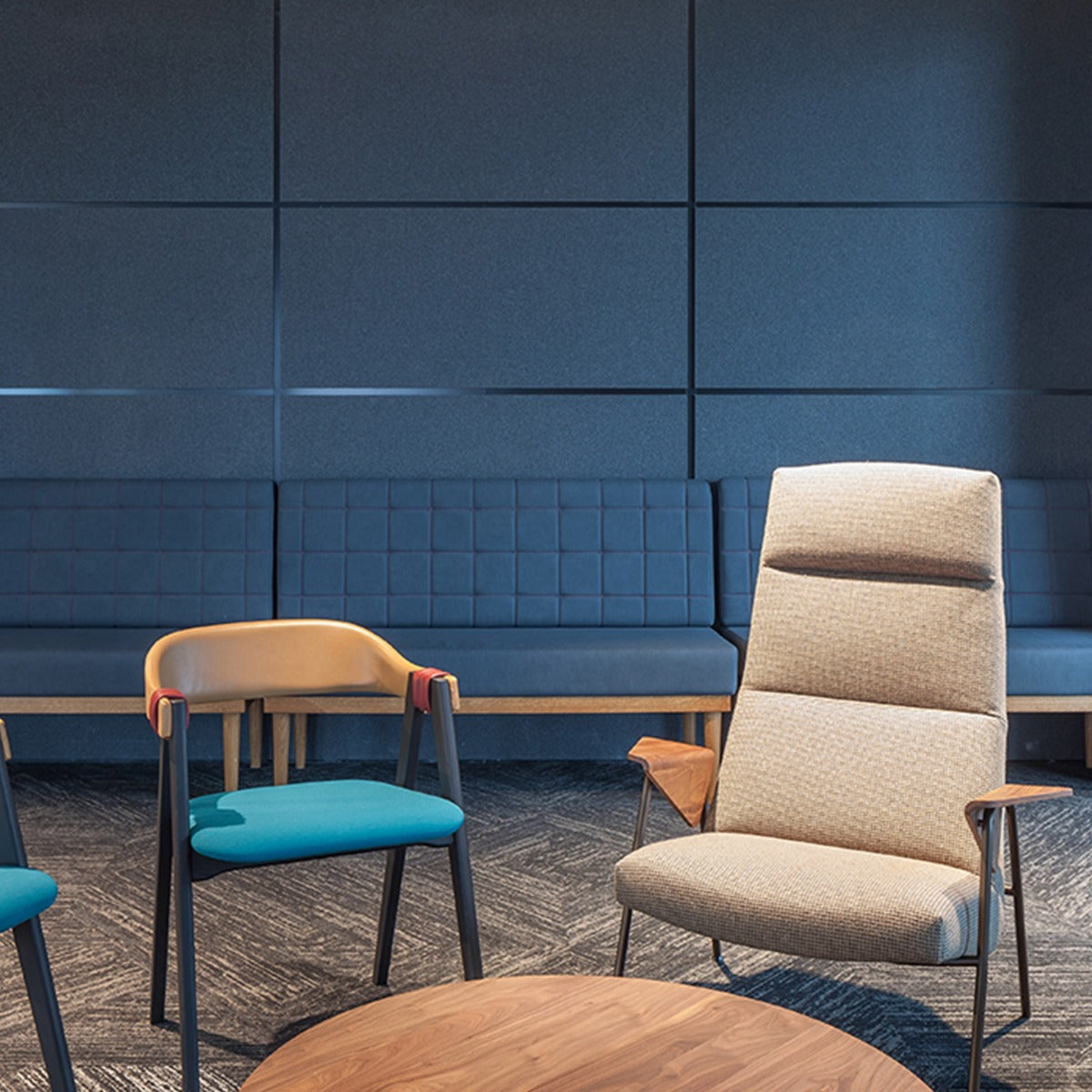


Collection:
Acoustic Screens
Acoustic screens give you privacy, zoning and a measurable acoustic improvement without putting up a wall. They're the go-to fix for open-plan offices where you need to break up sightlines and reduce desk-to-desk noise — but increasingly used in restaurants, cafés and meeting spaces too.
Three main types, each doing a different job:
Desk screens mount directly to a desk to interrupt the line of speech between colleagues. They need to sit higher than seated mouth height to actually work for privacy — anything shorter is just decoration.
Free-standing screens divide rooms without permanent fixings. Useful in flexible workspaces, hot-desking areas and spaces that get rearranged often.
Hanging screens suspend from the ceiling to break up large open volumes — great for atriums, breakout zones and double-height spaces where desk and floor screens would look lost.
We stock the full Autex Cascade and Vicinity ranges, plus suspended systems from Abstracta (Airflake, Airleaf, Airbloom, Aircone), free-standing dividers from De Vorm, and 14six8's modular kits. Most ship in 2–3 weeks; performance and lead time are listed on every product page.
Not sure whether you need screens, panels or both? Try our acoustic calculator — or get in touch and we'll talk it through.


14six8 'Groove' Acoustic Screen
Groove acoustic screens from 14six8 is acquired in kit form allowing for easy assembly and freedom of design and customisation.
Choose your option


De Vorm 'Mute Flow' Acoustic Screen - 2390 x 790mm
Mute Flow Room divider from De Vorm is a stylish PET felt panel which can be added to any space thanks to its integrated stand.
Choose your option


Autex 'Cascade' Acoustic Screens - 2400 x 1200mm
Autex Cascade is a range of free hanging acoustic screens which easily add comfort, seperation and privacy whilst improving acoustics.
Choose your option


Abstracta 'dB Floor Screen' - 800 x 1565 x 165mm
Choose your option

Abstracta 'Airflake XL' Hanging Screen
Choose your option


Abstracta 'Airflake' Hanging Screen
Choose your option


Abstracta 'Airleaf' Hanging Acoustic Screen
Choose your option


Abstracta 'Aircone' Hanging Acoustic Screens
Choose your option


Abstracta 'Airbloom' Hanging Acoustic Screen
Choose your option


Autex 'Vicinity Polka' Acoustic Desk Screens
Choose your option


Autex 'Vicinity Crest' Acoustic Desk Screens
Choose your option


Autex 'Vicinity Slate' Acoustic Desk Screens
Choose your option

Autex 'Vicinity Den' Acoustic Desk Screens
Choose your option

Autex 'Vicinity Hedge' Acoustic Desk Screens
Choose your option


Autex 'Vicinity Haven' Acoustic Desk Screens
Choose your option


Autex 'Vicinity Nook' Acoustic Desk Screens
Vicinity Nook desk screens are a simple acoustic solution for modern workspaces, doubling as a physcial divider whilst adding absorption to the space.
Choose your option


Autex 'Vicinity Sol' Acoustic Desk Screens
Bring balance and comfort to your workspace using Vicinity Sol acoustic desk screens from Autex, available in all Cube colours. Sold in packs.
Choose your option



About SONIO
As the world of acoustics has grown, so has the demand for fast, affordable and attractive solutions to common acoustic issues. Sonio was launched as an accessible supplier of acoustic panels which are simple to install, but also provide effective sound absorption to reduce reverberation within your space. With over a decade of experience specialising in acoustics, our team can provide you with clear recommendations on what works and what doesn't.
FAQs
What's the difference between desk screens, free-standing screens and hanging screens?
What's the difference between desk screens, free-standing screens and hanging screens?
Desk screens clamp or fix to a desk and sit roughly 400-600mm above the desk surface — they break up sightlines and speech between adjacent workstations. Free-standing screens have weighted bases and divide whole areas, like portable walls. Hanging screens suspend from the ceiling and tend to be larger statement pieces that zone open-plan space. Each does a different job — buyers often combine them.
How tall does a desk screen need to be to actually work?
How tall does a desk screen need to be to actually work?
Higher than mouth height when seated. That's the rule of thumb most acoustic specifiers use. A typical seated mouth height is around 1150-1200mm from the floor, so a desk surface of 720mm needs a screen at least 450mm tall — and ideally a bit more — to interrupt direct speech between facing colleagues. Anything shorter looks like a screen but doesn't perform like one.
Do acoustic screens reduce noise as well as add privacy?
Do acoustic screens reduce noise as well as add privacy?
Yes, but they're a partial solution. Screens absorb sound on the surfaces facing them and block direct line-of-sound, which improves perceived noise levels and speech privacy. They don't reduce overall reverberation in a room as effectively as ceiling rafts or wall panels — for that, you usually want screens and panels working together. Most projects we see use a combination.
What absorption class should I expect from a screen?
What absorption class should I expect from a screen?
Most desk and free-standing screens fall in Class C or Class D (αw 0.30-0.55). That's because they're thinner than wall or ceiling absorbers, and there's a limit to how much absorption you can get from a 30-60mm panel. Hanging screens and larger dividers can reach Class B or in some cases Class A. The trade-off is honest: you choose screens for privacy and zoning first, with absorption as a bonus.
Will screens work in a restaurant or café?
Will screens work in a restaurant or café?
Yes — particularly hanging and free-standing types. They're useful for breaking up large volumes and creating intimate zones in otherwise open-plan rooms. For a restaurant with a serious noise problem, though, the most effective treatment is usually ceiling-based (rafts or baffles) because that's where the most reflective surface area is. Screens add atmosphere and incremental absorption.
Are acoustic screens easy to install?
Are acoustic screens easy to install?
Desk screens fit with desk clamps or grommet-mount brackets — typically a 5-minute job per screen. Free-standing screens need no installation at all; they just stand up on weighted bases. Hanging screens come with suspension kits and need access to the ceiling structure, which usually means a stepladder or scissor lift in commercial spaces. All fixings are included.
Can I get screens in custom colours or with branded printing?
Can I get screens in custom colours or with branded printing?
Yes. Most of the Autex range comes in 20+ stock colours, and several products (including Cascade and Cube-derived screens) can be cut, moulded or printed to bespoke designs. Lead times for custom finishes are typically 6-12 weeks rather than the standard 2-3.
Are they fire-rated and safe for offices and public spaces?
Are they fire-rated and safe for offices and public spaces?
Yes. Every screen we sell carries a UK/EU fire classification suitable for commercial environments — typically Euroclass B-s1,d0 or equivalent. Specific ratings are listed on each product page so you can match them to your building specification.